Industrial IoT security means protecting the sensors, controllers, and networked machines that run physical operations from cyberattacks that could halt production, damage equipment, or hurt people. If you do only one thing this quarter, make it this: build passive visibility into every device on your OT network and lock down the connections between your IT and OT environments. That single move addresses the two failure points behind most incidents we see.
We build our approach around NIST SP 800-82r3 and the ISA/IEC 62443 zone-and-conduit model, not because they're trendy, but because they're what auditors, insurers, and incident responders already expect you to follow. Collett Systems LLC has applied these frameworks across manufacturing and industrial clients in Southeastern Wisconsin, and the pattern holds: teams that get visibility and segmentation right avoid the incidents that take down teams who don't.
Before you touch a firewall rule, confirm you have:
- A current, accurate inventory of every OT asset, including shadow devices IT doesn't know about
- Passive monitoring in place so you can see traffic without injecting risk into control networks
- A documented boundary between IT and OT with defined, limited crossing points
Key Takeaways
Industrial IoT security succeeds when passive visibility, IT/OT segmentation, and disciplined remote-access governance are in place before more advanced controls get added.
| Point | Details |
|---|---|
| Start with visibility | Build a passive, protocol-aware asset inventory before deploying any active security tool. |
| Harden the IT/OT boundary | Most incidents cascade from IT compromise, so a DMZ and strict access controls between IT and OT matter most. |
| Follow NIST and ISA/IEC 62443 | Use NIST SP 800-82r3 for OT-specific controls and the zone-and-conduit model for segmentation design. |
| Govern vendor and remote access | Route third-party connections through jump hosts with MFA and time-limited, logged sessions. |
| Sequence your roadmap | Tackle quick wins like monitoring and MFA first; save legacy replacement and hardware isolation for long-term budget cycles. |
| Get expert help implementing it | Collett Systems LLC applies these frameworks through fixed per-user managed services for manufacturers and SMBs across Southeastern Wisconsin. |
Table of Contents
- What Makes Industrial IoT Security Different From Regular IoT
- Where Most IIoT Security Incidents Actually Start
- Which Standards Should Guide Your IIoT Security Program
- Building the Architecture: Visibility, Segmentation, and Device Lifecycle
- Specific Controls That Close the Gaps
- Governing Vendor Access and Third-Party Risk
- What an OT Incident Response Plan Needs That an IT Plan Doesn't
- Building a Realistic Roadmap: What to Fix First
- How Collett Systems Applies This Guidance for Real Clients
- Compliance Obligations You Can't Ignore in Industrial Environments
- Training Programs That Fit How Plant Floor Teams Actually Work
- What Real Industrial Breaches Teach About Prioritization
- How 5G, Edge Computing, and AI Are Reshaping the Threat Surface
- Getting IT and OT Security Teams to Actually Work Together
- Hardware Isolation vs. Software Controls: When to Choose Which
- Get Help Implementing Industrial IoT Security the Right Way
- Sources
- FAQ
What Makes Industrial IoT Security Different From Regular IoT
Industrial IoT covers the programmable logic controllers (PLCs), remote terminal units (RTUs), human machine interfaces (HMIs), historians, and engineering workstations that control physical processes. That's a different animal than a smart thermostat or a fleet of employee laptops, and treating it the same way is how security programs fail in the field.
Consumer IoT and enterprise IT rank confidentiality first. Industrial environments flip that hierarchy entirely:
- Availability and safety come first. A control system that goes offline can stop a production line or, worse, create a physical hazard.
- Integrity ranks second. If a sensor reading or a controller command gets altered, the process runs on bad data.
- Confidentiality ranks third. Data secrecy still matters, but it never overrides keeping the line running safely.
Operational constraints compound the problem. Many controllers run for extended periods without replacement. Patches require scheduled maintenance windows, which may be infrequent. Legacy protocols like Modbus and DNP3 were never built with authentication in mind, and real-time processes can't tolerate the latency that some security tools introduce.
Where Most IIoT Security Incidents Actually Start
Most industrial security incidents don't begin with an exotic zero-day aimed at a PLC. They begin somewhere far more ordinary, and that's good news if you know where to look.
- IT compromise cascading into OT. Dragos's Q2 2026 industrial ransomware analysis found that a large share of OT disruptions trace back to enterprise IT systems that were breached first, then used as a pivot point into the plant floor.
- Internet-facing edge devices. Remote terminal units, VPN concentrators, and gateway devices exposed directly to the internet remain a favorite entry point, and Dragos's same analysis flags them as a frequent initial access vector.
- Compromised credentials and abused remote-support tools. Attackers increasingly use the same remote monitoring and management (RMM) software your vendors use for legitimate support, which makes detection harder because the traffic looks routine.
- Legacy controllers with no authentication. Older PLCs often accept commands from anyone on the network segment, no password required, because they were designed for a pre-internet threat model.
- Flat networks with no segmentation. Once an attacker lands anywhere on an unsegmented OT network, they can reach everything on it.
- Monitoring gaps. Detection frequently lags the operational impact, meaning teams find out about a problem when a line stops, not when the intrusion started.
Industry data point: Enterprise compromise cascading into OT, plus exposed edge devices, together account for the majority of initial access paths Dragos tracked in Q2 2026. If you're triaging where to spend your next budget dollar, start there rather than chasing rare, headline-grabbing exploits.
CISA's edge device guidance backs this up directly: locking down remote management interfaces and internet-exposed devices produces a bigger drop in risk, faster, than almost any other single control.
Which Standards Should Guide Your IIoT Security Program
You don't need to invent your own framework. Three references cover almost everything a mid-sized industrial operation needs, and each does a different job.
- ISA/IEC 62443 operationalizes the zone-and-conduit model, which groups assets by criticality into zones and controls every conduit between them. It also defines security program maturity levels so you can benchmark where you stand.
- NIST Cybersecurity Framework (CSF), paired with CVSS scoring from the National Vulnerability Database, gives you a repeatable way to triage vulnerabilities by business impact rather than by raw severity score alone.
Tailor the depth of adoption to asset criticality. A safety-critical PLC controlling a pressure vessel deserves full ISA/IEC 62443 zone treatment; a non-critical environmental sensor doesn't need the same rigor.
Pro Tip: Don't try to implement all three frameworks simultaneously. Start with an asset criticality assessment, then apply NIST SP 800-82r3's DMZ and monitoring guidance to your highest-risk zones first. Expand from there.
Building the Architecture: Visibility, Segmentation, and Device Lifecycle
Three architectural moves do more heavy lifting than any single product purchase, and they build on each other in a specific order.
Start with passive visibility. You cannot secure what you cannot see, and industrial networks routinely have shadow devices nobody documented, making the role of monitoring stations in commercial security critical for effective detection and response. Protocol-aware passive monitoring across Purdue Levels 1 through 3 (the field devices, controllers, and supervisory systems) lets you build an asset inventory without sending a single packet that could disrupt a sensitive process. This is fundamentally different from IT network scanning, which actively probes devices and can crash fragile legacy controllers.

Segment by zone and conduit. Once you know what's on the network, group it. Industrial firewalls sitting at defined boundaries, paired with a DMZ pattern between IT and OT, stop lateral movement before it starts. Micro-segmentation goes further where it's feasible, but map your actual control flows first. One documented insight from OT defenders bears repeating: blocking traffic without understanding what's actually flowing between systems risks halting production, which is exactly the outcome you're trying to prevent.
Manage the device lifecycle deliberately. Secure provisioning at deployment, patch testing under real field conditions (not just in a lab), and a documented plan for end-of-life devices that can no longer receive vendor support all matter more in OT than in IT, because a PLC you can't patch might need to run for another decade regardless.
Engineering workstations deserve special attention here. They're often the single most privileged machine on the OT network, capable of reprogramming controllers directly, yet they frequently run with local administrator accounts and no privileged access management at all.
- Inventory every OT asset with a passive, protocol-aware tool before you install anything active
- Define zones by criticality and business function, not by physical location alone
- Map real traffic flows before writing a single segmentation rule
- Treat engineering workstations as tier-one privileged assets
Pro Tip: If your team only has bandwidth for one architectural project this year, choose passive visibility. Segmentation decisions made without accurate traffic data tend to get walked back within months because they broke something nobody accounted for.
Specific Controls That Close the Gaps
Architecture sets the shape of your defense. These are the specific technologies that fill it in.
- Secure boot and firmware integrity checks verify that a device is running unmodified, vendor-signed firmware every time it powers on, where the hardware supports it. Not every legacy PLC does, which is itself a data point for your replacement roadmap.
- Mutual TLS and device identity certificates replace the old assumption that anything on the network segment is trusted. Certificate lifecycle management becomes a real operational task once you deploy this at scale, not a one-time setup.
- Encryption trade-offs are real in OT. Some legacy protocols and real-time control loops can't absorb the latency that full encryption introduces. Apply it where the process tolerates the delay, and rely on network segmentation to cover the gaps where it doesn't.
- Jump servers for remote access put a single, monitored, logged checkpoint between any outside connection and the OT network. Pair this with time-limited credentials and full session recording, so vendor access leaves an audit trail instead of a blind spot.
- Unidirectional gateways, also called data diodes, physically enforce one-way data flow for the small number of connections where information genuinely only needs to travel outward, such as historian data feeding a business intelligence dashboard. They cost more and take longer to deploy than software controls, but they eliminate an entire category of attack path for the connections that matter most.
Governing Vendor Access and Third-Party Risk
Vendors and remote-support tools show up in Dragos's incident data again and again as the path an attacker used, not because vendors are careless, but because remote access built for convenience rarely gets revisited once it's working.
- Route every vendor connection through a jump host, require multi-factor authentication on that connection, and grant access for a defined time window tied to the actual maintenance ticket, not an open-ended standing credential.
- Write security requirements into the statement of work. Any vendor touching OT equipment should contractually agree to your access policy, your logging requirements, and your incident notification timeline before the contract is signed, not after something goes wrong.
- Maintain an allowed-tools list for remote monitoring and management software. If your team didn't approve a specific RMM tool, it shouldn't have a path into your OT network, full stop.
- Review privileged access on a set schedule, and move toward just-in-time provisioning so standing access simply doesn't exist for accounts that only need occasional entry.
What an OT Incident Response Plan Needs That an IT Plan Doesn't
A ransomware playbook written for office laptops will get someone hurt if you try to run it against a live production line. OT incident response needs its own structure, built around a different set of priorities.
Your response team needs operations and safety engineers sitting alongside IT security staff from day one, not brought in after containment decisions are already made. NIST's OT security guidance explicitly calls for this cross-functional structure because a decision that looks obvious from a security standpoint, like pulling a device offline immediately, can create a physical safety hazard if a process depends on that device staying active.
- Define shutdown authority in advance: who can order a process stop, and under what conditions
- Document evidence handling procedures that preserve forensic data without disrupting active control processes
- Build in regulator and insurer notification steps as a scripted part of the playbook, not an afterthought
- Keep backups isolated from the production network and test restores on a regular schedule, not just when you remember to
Pro Tip: Test your restore process on hardware that mirrors production, not just in a lab environment. A backup that restores cleanly to a test server but fails on the actual PLC firmware version does you no good during a real event.
Recovery sequencing matters as much as the technical restore. Validate safety systems before you bring a process back online, every time, even when the pressure to restart is intense.
Building a Realistic Roadmap: What to Fix First
Not every control belongs in month one. A roadmap that tries to do everything at once usually stalls, because OT changes require maintenance windows that don't come around often.
- Quick wins (0 to 3 months): Passive asset inventory and monitoring, locking down remote access with MFA, and basic network segmentation between IT and OT. These require minimal capital investment and don't demand a production shutdown to implement.
- Medium projects (3 to 12 months): Micro-segmentation informed by real traffic mapping, secure device provisioning processes, and fully audited, time-limited vendor session access.
- Long-term investments (1 to 3 years): Replacing unpatchable legacy assets, deploying hardware isolation like data diodes for critical one-way data flows, and maturing OT-specific detection capabilities.
The growing device count across industrial networks means the asset inventory step only gets harder to catch up on the longer you wait. Cost drivers typically break down into three buckets: legacy replacement (the most expensive line item by far), specialized OT monitoring tools, and the labor cost of maintenance-window-constrained implementation work that can't happen on a normal IT deployment schedule.
How Collett Systems Applies This Guidance for Real Clients
I've spent years watching manufacturers try to bolt IT security tools onto OT networks that were never designed for them, and it rarely ends well. The framework above only works when someone owns it day to day.
Collett Systems LLC builds these standards into how we run managed IT for manufacturers: 24/7 monitoring, fixed per-user pricing with no surprise tiers, and a fully-loaded security stack through our Total Secure offering for smaller teams.
- Over 150 local organizations trust us with infrastructure they depend on daily
- We bring hands-on experience with CJIS compliance requirements for regulated environments
- Our clients get documented, measurable security improvements, not vague assurances
Dustin Collett
Compliance Obligations You Can't Ignore in Industrial Environments
Regulatory exposure in industrial IoT deployments varies sharply by sector, and treating compliance as a single checkbox is how gaps slip through. A food and beverage manufacturer, a critical infrastructure operator, and a government contractor each carry different obligations layered on top of general cybersecurity practice.
Critical infrastructure sectors, particularly energy and water, increasingly face sector-specific reporting mandates that require notifying regulators within a defined window after a confirmed incident. Manufacturing operations selling to government agencies or handling law enforcement data often need to demonstrate CJIS compliance, which imposes specific requirements on access control, encryption, and audit logging that go beyond general IT hygiene. Insurance underwriters have also tightened requirements for cyber policies covering OT environments, frequently asking for documented segmentation, MFA on remote access, and evidence of regular vulnerability assessment before they'll issue or renew coverage.
Data protection rules add another layer. Industrial data protection isn't only about trade secrets. Historian data, production metrics, and even seemingly mundane sensor logs can carry contractual confidentiality obligations tied to customer agreements, and a breach exposing that data can trigger notification duties independent of any safety impact.
The practical takeaway: build a compliance mapping exercise into your security roadmap early. Identify which regulations, contracts, and insurance requirements actually apply to your specific facilities and customer relationships, then align your technical controls to satisfy the strictest of them rather than treating each requirement in isolation. Retrofitting compliance evidence after a regulator or auditor asks for it costs far more than documenting controls as you build them.
Training Programs That Fit How Plant Floor Teams Actually Work
Generic phishing-simulation training built for office workers falls flat on a plant floor, and security teams that force it anyway waste both budget and goodwill. Operators and technicians need training scoped to the systems they actually touch.
Start with role-specific content. An operator running an HMI needs to recognize when a screen is behaving unexpectedly and know exactly who to call, not a lecture on password complexity. Engineering staff who configure PLCs need deeper training on secure remote access practices and how to spot a suspicious vendor request, since they're the ones most likely to receive one directly. Maintenance contractors and third-party technicians need a condensed version of your access policy delivered before they ever touch equipment, not buried in a contract they signed months earlier.
Frequency matters more than length. Short, focused sessions every quarter beat a single annual hour that everyone forgets by the following week. Tie training to real incidents where possible, industry examples work better than hypothetical scenarios because plant staff recognize the operational stakes immediately.
Build a simple reporting culture too. Frontline staff are often the first to notice something off, an HMI behaving strangely, an unfamiliar USB drive plugged into a workstation, a vendor asking for access outside the usual window. If reporting that observation feels like paperwork or blame, people stop doing it. Make the reporting path as short as a phone call or a single message to a known contact, and make sure staff hear back when their report leads to action. That feedback loop is what turns a training program into an actual detection layer instead of a compliance exercise.
What Real Industrial Breaches Teach About Prioritization
The incidents that make headlines rarely start where the headlines suggest. Ransomware groups targeting manufacturing plants over the past several years have repeatedly followed the same pattern documented in Dragos's Q2 2026 analysis: a compromise lands first on the corporate IT network, often through a phished credential or an exposed remote access tool, and only later spreads into OT because no meaningful boundary existed between the two.
The operational impact in these cases usually isn't a hacker manually manipulating a PLC. It's ransomware encrypting the historian, the manufacturing execution system, or the engineering workstations that operators depend on to run the line, forcing a plant to shut down not because the physical process was attacked directly, but because the systems surrounding it became unusable. That distinction matters for where you invest: the boundary between IT and OT, and the availability of the supporting systems around your controllers, often determines whether an IT-side breach becomes a plant-floor shutdown.
A recurring lesson across these incidents is how long detection took relative to when the intrusion actually began. Enterprise compromises frequently sat undetected for weeks before the OT-side impact became visible, which lines up with the monitoring gaps documented in industry threat reporting. Organizations that had passive OT monitoring in place caught the lateral movement before it reached production; those that didn't found out when the line stopped.
The practical lesson isn't exotic. It's that the unglamorous basics, network segmentation, monitoring the IT/OT boundary, and locking down remote access, would have interrupted nearly every one of these incident chains before they reached the plant floor.
How 5G, Edge Computing, and AI Are Reshaping the Threat Surface
Emerging technology is expanding what "industrial IoT" even means, and each addition changes your risk calculus differently.
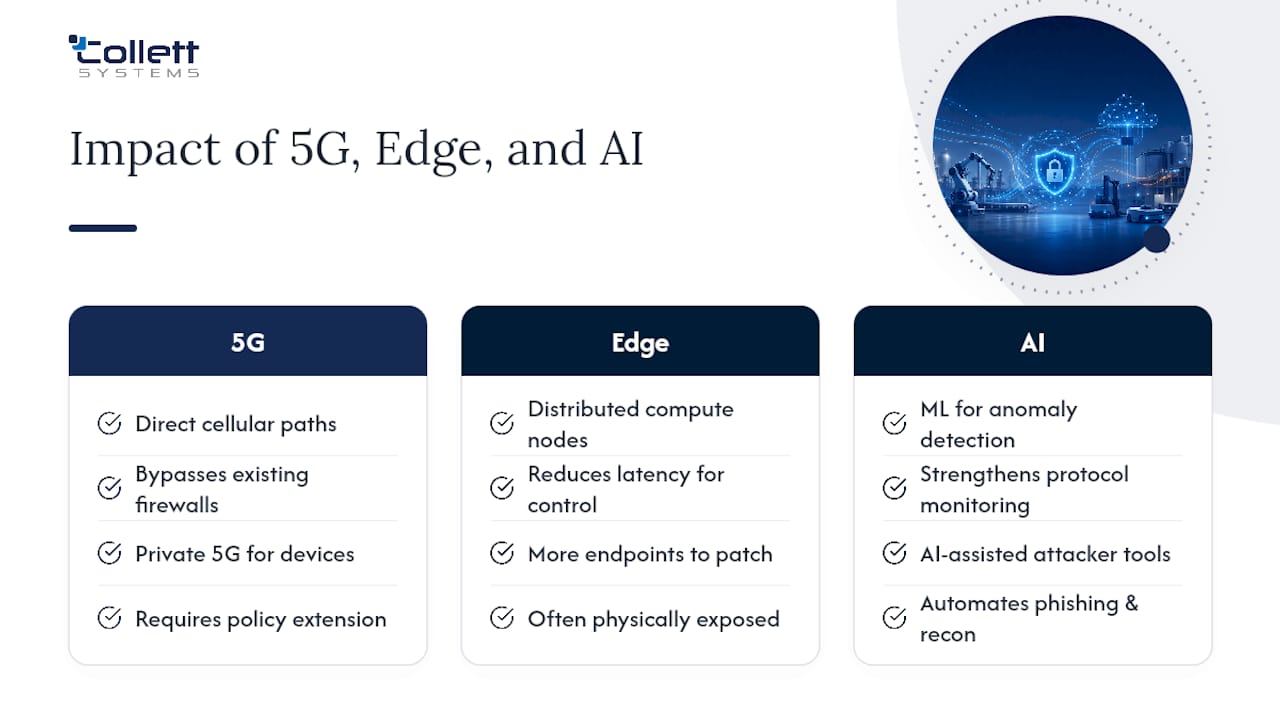
5G-connected industrial sensors and private 5G networks are pulling more field devices directly onto cellular infrastructure, bypassing the traditional wired network boundary security teams have relied on for segmentation. That's a genuine capability gain for remote or distributed facilities, but it also means a device can now reach the internet through a path your existing firewall never sees, unless you extend visibility and policy enforcement to cover it explicitly.
Edge computing pushes processing and decision-making out of the centralized control room and onto distributed compute nodes closer to the machines themselves. That reduces latency for real-time control, but it also multiplies the number of compute endpoints running software that needs patching, monitoring, and secure configuration, often in physically less secure locations than a locked server room.
AI is showing up on both sides of the fight. Predictive maintenance models and anomaly detection tools built on machine learning are getting genuinely useful at catching abnormal equipment behavior before it becomes a failure, and that same pattern-recognition capability strengthens protocol-aware monitoring for security purposes. On the other side, attackers are using AI-assisted tools to craft more convincing phishing attempts targeting engineering and maintenance staff, and to automate reconnaissance against internet-facing OT assets faster than manual scanning ever could.
None of this changes the fundamentals. Visibility, segmentation, and access governance still form the foundation. It does mean your asset inventory needs to explicitly include 5G-connected devices and edge compute nodes, not just the traditional PLC and HMI inventory most teams still default to.
Getting IT and OT Security Teams to Actually Work Together
The friction between IT and OT security teams isn't really a technology problem. It's an organizational one, and it shows up in nearly every industrial security assessment we run.
IT teams are trained to patch fast and prioritize confidentiality. OT teams are trained to protect uptime and safety above everything else, and they've usually seen a well-intentioned IT patch or scan take down a production line at some point in their career, which makes them understandably resistant to IT's usual playbook. Neither team is wrong. They're optimizing for different failure modes, and a security program that ignores that tension will keep hitting the same wall.
The fix starts with shared visibility rather than shared authority. Give both teams access to the same asset inventory and the same passive monitoring data, so decisions get made from a common picture of what's actually on the network instead of two separate, incomplete views. From there, establish a joint change-approval process for anything touching the IT/OT boundary, with representation from both sides required before a firewall rule or a segmentation change gets pushed live.
Governance structure matters more than most organizations expect. A steering group that includes plant operations leadership, not just IT and security staff, keeps decisions grounded in what's operationally feasible rather than what looks clean on a network diagram. Organizations that formalize this cross-functional structure, rather than leaving it to informal cooperation between whichever managers happen to get along, consistently move faster on segmentation and monitoring projects because disagreements get resolved through a defined process instead of an escalation fight during an actual incident.
Hardware Isolation vs. Software Controls: When to Choose Which
Reach for hardware isolation, like a data diode, only when a connection genuinely needs to be one-way and the consequence of compromise is severe: safety systems, regulatory reporting feeds, critical historian exports. Everywhere else, software layering, passive monitoring, and disciplined vendor governance deliver comparable risk reduction at a fraction of the cost and deployment time. If you're not sure which category a connection falls into, map the actual data flow before deciding. That single step resolves most of these arguments on its own.
Get Help Implementing Industrial IoT Security the Right Way
Reading a framework document and actually implementing zone-and-conduit segmentation on a live production network are two very different projects. Most manufacturing IT teams we talk to know exactly what NIST SP 800-82r3 recommends. What they lack is the hands-on time to build passive monitoring, map traffic flows, and lock down vendor access without a maintenance window turning into an unplanned outage.
That's the gap Collett Systems LLC fills. Our managed IT services for manufacturers come with 24/7 monitoring, fixed per-user pricing with no surprise tiers, and a security stack built around the same standards covered in this article, already fully loaded rather than sold as add-ons. If your team needs a starting point rather than a full engagement, our Total Secure offering gives solo operators and very small teams a fixed-cost path to the same core protections. And if you're not sure where your current environment stands against NIST or ISA/IEC 62443, a cybersecurity risk assessment gives you a documented baseline before you commit to a bigger project.
Book an assessment with our team and get a clear picture of where your IT/OT boundary stands today.
Sources
- Dragos industrial ransomware analysis Q2 2026
- CISA - Edge device security / cybersecurity best practices
- ISA/IEC 62443 series of standards
FAQ
What Does Industrial IoT Mean?
Industrial IoT (IIoT) refers to the networked sensors, controllers, and machines, such as PLCs, RTUs, and HMIs, that monitor and control physical industrial processes like manufacturing lines, utility grids, and building systems.
What Is IoT Security?
IoT security is the set of practices and technologies that protect connected devices, and the networks and data they interact with, from unauthorized access, manipulation, or disruption. In industrial settings, it extends to protecting the safety and availability of the physical processes those devices control.
What Are the Top Vulnerabilities in Industrial IoT?
The most common vulnerabilities include internet-facing edge devices, compromised credentials on remote-support tools, legacy controllers with no built-in authentication, flat unsegmented networks, and monitoring gaps that let intrusions go undetected for weeks.
What Are the 5 C's of IoT?
Definitions of the "5 C's" vary across the industry, and no single version has become the accepted standard for industrial IoT security. Rather than force a specific list, focus on the priorities that consistently matter in practice: visibility, segmentation, authentication, monitoring, and governance of third-party access.
How Does Collett Systems LLC Help With IIoT Security?
Collett Systems LLC applies NIST SP 800-82r3 and ISA/IEC 62443 guidance through managed IT services with fixed per-user pricing, 24/7 monitoring, and a fully-loaded security stack for manufacturers and small to mid-sized businesses in Southeastern Wisconsin.