IT/OT convergence is the deliberate integration of enterprise information technology (IT) systems with industrial operational technology (OT) systems to turn raw operational data into measurable business outcomes. For manufacturers and critical infrastructure operators, that integration means connecting PLCs, SCADA systems, and sensors to cloud analytics, ERP platforms, and enterprise dashboards. The payoff is real: predictive maintenance, reduced unplanned downtime, and faster decisions at every level of the organization.
Before you go further, three actions set every successful program apart from the ones that stall:
- Assess asset visibility first. You cannot protect or connect what you cannot see. Run a passive OT asset discovery before touching any architecture.
- Run a controlled pilot. A read-only historian mirror with a limited DMZ proves value without risking production.
- Enforce segmentation from day one. Zone-and-conduit architecture and an IT/OT DMZ are non-negotiable starting points, not Phase 3 additions.
The rest of this guide gives you the roadmap, the standards, the vendor context, and the governance framework to execute all three.
Key Takeaways
IT/OT convergence delivers measurable operational value only when security architecture, governance, and phased execution are built in from the start, not added after the first pilot.
| Point | Details |
|---|---|
| Start with passive asset discovery | Complete an OT asset inventory before connecting any systems; passive tools observe without disrupting control loops. |
| Segmentation is non-negotiable | Zone-and-conduit architecture and an IT/OT DMZ must be in place before OT data flows to enterprise systems. |
| Phase the program deliberately | Governance first, then a 60, 90 day read-only pilot, then staged scaling with unified monitoring. |
| Use standards as procurement language | IEC 62443 and NIST 800-82 give your RFPs objective security requirements vendors can be held to. |
| Collett Systems LLC for manufacturers | Collett Systems LLC provides OT-aware managed IT, asset discovery, DMZ deployment, and 24/7 monitoring for manufacturers in Southeastern Wisconsin. |
Table of Contents
- How IT and OT differ in priorities, lifecycles, and risk profiles
- Why organizations are converging IT and OT right now
- The three forms IT/OT convergence actually takes
- Security risks IT/OT convergence introduces, and the controls that address them
- A phased roadmap for IT/OT convergence that protects production
- Real use cases with realistic scope and measurable outcomes
- Governance and organizational change that keeps data reliable
- The technology categories and vendors that matter in an IT/OT stack
- Common mistakes that derail IT/OT convergence projects
- What authoritative government and industry guidance says you should do
- Collett Systems LLC helps manufacturers execute IT/OT convergence securely
- What I'd tell every plant manager starting an IT/OT program today
- Sources
How IT and OT differ in priorities, lifecycles, and risk profiles
Understanding IT and OT integration starts with recognizing that these two domains were built for fundamentally different jobs. IT systems prioritize confidentiality, integrity, and availability, in that order, with regular patch cycles measured in weeks and hardware refreshes every three to five years. OT systems flip that priority stack entirely: availability and safety come first, confidentiality is secondary, and equipment lifecycles routinely stretch 15, 25 years.
That gap creates specific risk vectors. An IT security team that applies standard patch cadence to a PLC running a production line can trigger an unplanned outage. A firmware update that takes an enterprise server offline for 20 minutes is an inconvenience; the same event on a water treatment controller is a safety incident. OT protocols like Modbus, DNP3, and PROFINET were designed for deterministic performance, not encrypted communication, so they carry no native authentication. Connecting them to enterprise networks without adapted controls exposes them to threats they were never designed to resist.
The cultural gap is just as real as the technical one. OT engineers measure success in uptime and throughput. IT teams measure it in patch compliance and incident response time. Neither metric is wrong; they just require a shared vocabulary before any integration project can succeed.
Pro Tip: When presenting convergence risk to OT stakeholders, frame every control in terms of uptime protection, not data security. "This segmentation prevents a ransomware event from reaching the production floor" lands far better than "this reduces our attack surface." OT teams respond to operational consequences, not abstract threat models.
Why organizations are converging IT and OT right now
The drivers behind IT/OT convergence are concrete and accelerating. Industrial IoT (IIoT) sensors have dropped in cost to the point where a mid-sized manufacturer can instrument an entire production line for a fraction of what it cost five years ago. Edge computing nodes now sit close enough to the machine to process data locally and push only relevant signals to the cloud, reducing latency and bandwidth costs simultaneously. Cloud analytics platforms make it practical to run machine learning models on operational data without building on-premises data science infrastructure.

Cisco's IT/OT convergence white paper identifies four specific deliverables driving adoption: edge computing for real-time decisions, predictive maintenance, wireless deployments across plant floors, and cybersecurity architectures that require IT and OT teams to collaborate. Supply chain pressures add urgency: manufacturers that cannot share real-time production status with suppliers and customers are at a competitive disadvantage.
The primary benefits leaders should expect:
- Predictive maintenance: Sensor data analyzed against historical failure patterns can flag equipment degradation before it causes downtime. Unplanned downtime is consistently one of the largest cost drivers in discrete and process manufacturing.
- Improved overall equipment effectiveness (OEE): Real-time visibility into machine utilization, quality rates, and availability lets operations teams act on losses the same shift they occur rather than the next week.
- Cost reduction: Consolidating OT and IT monitoring infrastructure reduces tool sprawl and the labor cost of running parallel support organizations.
- Faster time to market: Digital thread visibility from raw material to finished goods lets engineering and operations teams identify bottlenecks and iterate faster.
- AI and ML on OT data: BizTech Magazine's 2026 reporting highlights hybrid-cloud and data-governance patterns that let manufacturers run AI and ML models on converged OT data while protecting availability and compliance requirements.
Three use cases that consistently deliver measurable ROI:
Predictive maintenance: Vibration, temperature, and current sensors on rotating equipment feed an ML model that predicts bearing failure 48, 72 hours in advance. The outcome is a planned maintenance window instead of an emergency repair.
Remote monitoring and diagnostics: OT engineers access plant-floor data through authenticated jump servers rather than direct VPN tunnels into the control network. Vendors can commission and troubleshoot equipment remotely without standing access to the production network.
Digital twin for process simulation: A virtual replica of a production line, fed by live OT data, lets process engineers test parameter changes before applying them to physical equipment. The result is faster changeovers and fewer quality escapes.
The three forms IT/OT convergence actually takes
PTC's convergence framework identifies three distinct types of convergence, and choosing the right starting point depends on your current infrastructure, risk tolerance, and organizational readiness.
Physical convergence involves connecting OT hardware to IT infrastructure through edge gateways, protocol converters, or retrofitted sensors. A legacy CNC machine with no native network interface gets an edge gateway that translates its serial output into an IP-addressable data stream. Physical convergence is often the first step, but it immediately expands the attack surface, which is why segmentation must accompany it.
Software and data convergence connects OT data historians, SCADA systems, and MES platforms to IT analytics, ERP, and cloud services. Tools like PTC's Kepware act as connectivity middleware, translating OT protocols into formats that enterprise applications can consume. ThingWorx sits above that layer as an IIoT application platform where the data becomes dashboards, alerts, and ML model inputs. This type of convergence carries the highest data-governance complexity because it creates data flows that cross the IT/OT boundary continuously.
Organizational and process convergence is the hardest and most often skipped. It means shared change-management processes, joint incident response procedures, and cross-functional teams where OT engineers and IT security staff have defined roles in the same workflows. Without this layer, physical and software convergence projects tend to stall or create shadow IT situations where OT teams bypass controls to maintain uptime.
The type you start with shapes your risk profile and timeline. Physical convergence can be piloted in weeks; organizational convergence takes quarters. Most successful programs run all three in parallel, with organizational work starting before the first gateway goes live.
Security risks IT/OT convergence introduces, and the controls that address them
Connecting OT to IT networks does not just add capability; it adds exposure. NSTAC and CISA's IT/OT convergence report is direct: connecting OT to IT increases OT exposure to malware and nation-state threats, and lack of investment is the largest single impediment to securing converged environments. Protiviti's January 2026 analysis adds that legacy OT devices and third-party vendor dependencies amplify ransomware and supply-chain risk specifically in manufacturing environments.
The primary risks, mapped to their controls:
| Risk | Control | Standard Reference |
|---|---|---|
| Expanded attack surface from new connectivity | Zone-and-conduit segmentation, IT/OT DMZ | IEC 62443, NIST 800-82 |
| Legacy OT devices with no authentication | Protocol-aware industrial firewalls, data diodes | IEC 62443 SL-1 baseline |
| Lateral movement from IT to OT | Micro-segmentation, authenticated jump servers, just-in-time access | NIST 800-82 Rev. 3 |
| Ransomware propagation | Network segmentation, offline backups, OT-specific EDR where supported | NIST 800-82, IEC 62443 |
| Supply-chain and third-party exposure | Vendor access controls, procurement language, supply-chain cyber requirements | NSTAC/CISA guidance |
| Flat networks and shared credentials | Zero-trust adaptations, MFA for OT access, federated identity | nCluster 2026 security guide |
Google Cloud's OT security blueprint recommends OT-specific DMZs, encrypted unidirectional OT-to-cloud data flows, and hybrid approaches for air-gapped OT workloads where full cloud connectivity is not feasible. The blueprint's operational checklist maps directly to the controls above and provides architecture patterns for organizations moving OT workloads toward cloud analytics.
Halkwinds Research's 2026 manufacturing cybersecurity report finds that asset inventories, IEC 62443 zone-and-conduit architectures, and protocol-aware industrial firewalls deliver the highest risk reduction per dollar spent, making them the right starting point for any OT security investment.
Pro Tip: Never test a new security control directly on production OT equipment. Validate firewall rules, segmentation changes, and protocol filters in a mirrored pilot environment or a digital twin first. A misconfigured industrial firewall rule can drop legitimate control traffic and cause the same unplanned downtime you are trying to prevent.
A phased roadmap for IT/OT convergence that protects production
A phased approach is not just a best practice; for small and medium manufacturers, it is the only approach that keeps production running while the program builds credibility. ToolingU's guidance for SMMs recommends starting with asset visibility and phased analytics rather than attempting a full-scale architecture change.
-
Phase 0: Governance and executive alignment. Define decision criteria, assign a cross-functional steering group, and set measurable KPIs before any technology is deployed. Without executive alignment on what success looks like, pilots lose funding at the first sign of friction.
-
Phase 1: Passive OT asset discovery and risk tiering. Passive discovery tools observe network traffic without sending packets to OT devices, which means no risk of disrupting control loops. The output is a complete OT asset inventory with firmware versions, protocol types, and communication patterns. Risk-tier every asset: safety-critical controllers, process-critical devices, and monitoring-only endpoints each get different treatment in the architecture.
-
Phase 2: Controlled pilot. Deploy a read-only historian mirror that pulls data from OT systems without writing back to them. Add a limited IT/OT DMZ with protocol-aware firewall rules and authenticated jump servers for any remote access. A well-scoped pilot typically runs 60, 90 days and should produce measurable outcomes: a baseline OEE metric, a documented asset inventory, and at least one validated use case (predictive maintenance is the most common first win).
-
Phase 3: Staged scaling and unified monitoring. Expand the DMZ and historian architecture to additional production lines or sites based on pilot results. Introduce SIEM integration so OT events appear in the same monitoring console as IT alerts. Automate routine data flows and begin building the cross-functional governance processes that sustain the program long-term.
Pro Tip: If your team does not have dedicated OT security expertise, start with a managed services partner and a small pilot rather than hiring and building in-house. The fastest way to damage an IT/OT program is to move faster than your internal capability can support. A managed partner gives you the architecture and monitoring coverage while your team builds the knowledge to take over.
Real use cases with realistic scope and measurable outcomes
Abstract benefits are easy to promise. These four use cases represent deployments that manufacturers actually complete, with the technology stack and the metrics that matter.
Predictive maintenance on rotating equipment
Scope: Vibration and temperature sensors on motors, pumps, and compressors, connected through an edge gateway to a cloud analytics platform. Typical stack: IIoT sensors, edge compute node, OT historian, cloud ML platform (Google Cloud Vertex AI is a common choice for manufacturers already in the Google ecosystem). Achievable outcome: Reduction in unplanned downtime on instrumented assets, with maintenance windows planned during scheduled production gaps rather than emergency responses.
Remote diagnostics and vendor commissioning
Scope: Authenticated jump server in the IT/OT DMZ gives OEM vendors time-limited, audited access to specific OT assets for commissioning and troubleshooting. No standing VPN access to the control network. Typical stack: Privileged access management (PAM) platform, jump server, DMZ firewall, session recording. Achievable outcome: Faster mean time to repair (MTTR) for vendor-supported equipment, with a complete audit trail of every remote session.
Supply chain visibility
Scope: Real-time production status data from MES and OT historian feeds into an ERP or supply chain platform, giving procurement and logistics teams accurate lead times. Typical stack: OT historian, MES integration layer, ERP connector (SAP, Oracle, or Microsoft Dynamics). Achievable outcome: Reduced expediting costs and improved on-time delivery rates as production bottlenecks become visible before they affect customer commitments.
Digital twin for process simulation
Scope: A virtual model of a production line, fed by live OT data, used by process engineers to simulate parameter changes before applying them to physical equipment. Typical stack: PTC ThingWorx or a similar IIoT platform, OT historian, simulation software. Achievable outcome: Faster changeover times and fewer quality escapes from untested process changes. The data and integration effort for this use case is higher than the others; expect 3, 6 months of data collection before the model is reliable enough to drive decisions.
Governance and organizational change that keeps data reliable
Technology without governance produces unreliable data and unresolvable disputes about who owns what. The organizational layer of IT/OT convergence requires three specific structures.
Procurement language and vendor requirements. Every new OT device purchase should include contractual requirements for secure-by-design features, a defined patch and vulnerability support lifecycle, and supply-chain cyber requirements for the vendor's own software dependencies. NSTAC and CISA specifically recommend OT-specific procurement language as a foundational control. Without it, you inherit the vendor's security posture along with the equipment.
Cross-domain responsibilities (RACI). Assign clear ownership for the tasks that fall between IT and OT:
- OT asset inventory: OT engineering owns the asset register; IT security owns the monitoring and alerting layer.
- Patching approvals: OT engineering approves all patch windows; IT security provides the vulnerability intelligence and coordinates scheduling.
- Incident response: Joint team with defined escalation paths; OT retains authority over safety-critical shutdown decisions.
- Data ownership: Operations owns OT data; IT owns the analytics infrastructure. Both sign off on data-sharing agreements with third parties.
KPIs and dashboard metrics. Track these at the program level:
- Mean time to repair (MTTR) for OT incidents
- Unplanned downtime hours per month, by asset class
- Patch compliance rate for OT assets (with a separate target from IT, given OT constraints)
- Mean time between failures (MTBF) for instrumented equipment
- Percentage of OT assets with current inventory records
Governance for financial services IT compliance follows a similar RACI model, which illustrates how cross-domain ownership structures translate across regulated industries.
The technology categories and vendors that matter in an IT/OT stack
No single vendor covers the entire IT/OT stack, and no architecture should depend on one. The categories below represent the functional layers, with the vendors that appear most frequently in production deployments.
Industrial connectivity and gateways. Protocol translation and data collection from OT devices. PTC's Kepware is the most widely deployed connectivity platform in this category, supporting over 150 OT protocols and acting as the data bridge between PLCs and enterprise systems. Rockwell Automation's FactoryTalk suite covers connectivity, historian, and MES functions for Rockwell-native environments, making it a natural starting point for manufacturers already running Allen-Bradley PLCs.
IIoT platforms and historians. PTC ThingWorx sits above Kepware as an application development and analytics platform where OT data becomes dashboards, alerts, and ML model inputs. Rockwell's FactoryTalk Historian serves a similar function in its ecosystem.
Industrial firewalls and network security. Palo Alto Networks' industrial security offerings include protocol-aware firewall capabilities that inspect OT protocols like Modbus and DNP3 without disrupting control traffic. Cisco's industrial networking portfolio covers both the switching and routing infrastructure for converged networks and the security architecture patterns described in their IT/OT convergence white paper.
OT-specific threat detection. Nozomi Networks provides passive OT asset discovery and anomaly detection purpose-built for industrial environments. Its passive approach means it observes traffic without sending packets to OT devices, which is the only safe discovery method for production networks.
Cloud analytics and SIEM integration. Google Cloud's OT security blueprint describes how OT data flows securely from the plant floor to cloud analytics services, with architecture patterns for both connected and air-gapped environments. Google Cloud Vertex AI and BigQuery are common targets for OT data analytics workloads.
Vendor selection criteria to apply consistently:
- Protocol support for your specific OT environment (Modbus, DNP3, PROFINET, EtherNet/IP)
- Safety-first design: does the tool operate passively, or does it send traffic to OT devices?
- Lifecycle support commitment: will the vendor support the product for the life of your OT equipment?
- Managed service availability: can you get 24/7 monitoring without building an in-house SOC?
- Integration with existing PLC and SCADA infrastructure
A managed firewall service that understands OT protocol inspection is worth more than a general-purpose firewall with no industrial context, regardless of the vendor name on the box.
Common mistakes that derail IT/OT convergence projects
Most IT/OT convergence failures are not technology failures. They are process and planning failures that the technology then exposes.
Skipping the asset inventory. Organizations that begin connecting OT systems before completing a passive asset discovery routinely discover undocumented devices, unsupported firmware versions, and legacy systems with no patch path. The corrective action is straightforward: complete passive discovery before any architecture change. Nozomi Networks and similar tools make this a weeks-long exercise, not a months-long one.
Attempting full-scope convergence immediately. A manufacturer that tries to connect every production line, every site, and every OT system in a single project almost always stalls. The corrective action is a bounded pilot: one production line, one use case, one 90-day window. Prove the value, document the lessons, then scale.
Applying IT patch cadence to OT devices. Patching a PLC on the same schedule as a Windows server can cause control loop failures. OT patching requires vendor-approved maintenance windows, pre-tested firmware, and a rollback plan. The corrective action is a separate OT patch policy with OT engineering approval gates.
Poor segmentation. Flat networks where IT and OT devices share the same broadcast domain are the single most common vulnerability in converged environments, as nCluster's 2026 security guide documents. The corrective action is zone-and-conduit architecture with a dedicated IT/OT DMZ, implemented before any OT data flows to enterprise systems.
Weak vendor change control. Third-party vendors with standing remote access to OT systems are a documented ransomware entry point. The corrective action is just-in-time access through an authenticated jump server with session recording, replacing any standing VPN tunnels.
Pro Tip: When evaluating a vendor's proof-of-concept, run it in shadow mode first: deploy the tool in read-only, observation-only mode alongside your existing environment and measure its outputs against known baselines before giving it any active role. A vendor POC that cannot demonstrate value in shadow mode will not improve in production.
What authoritative government and industry guidance says you should do
The standards and government reports that shape IT/OT security are not abstract frameworks. They translate directly into the architecture decisions and procurement language that protect production environments.
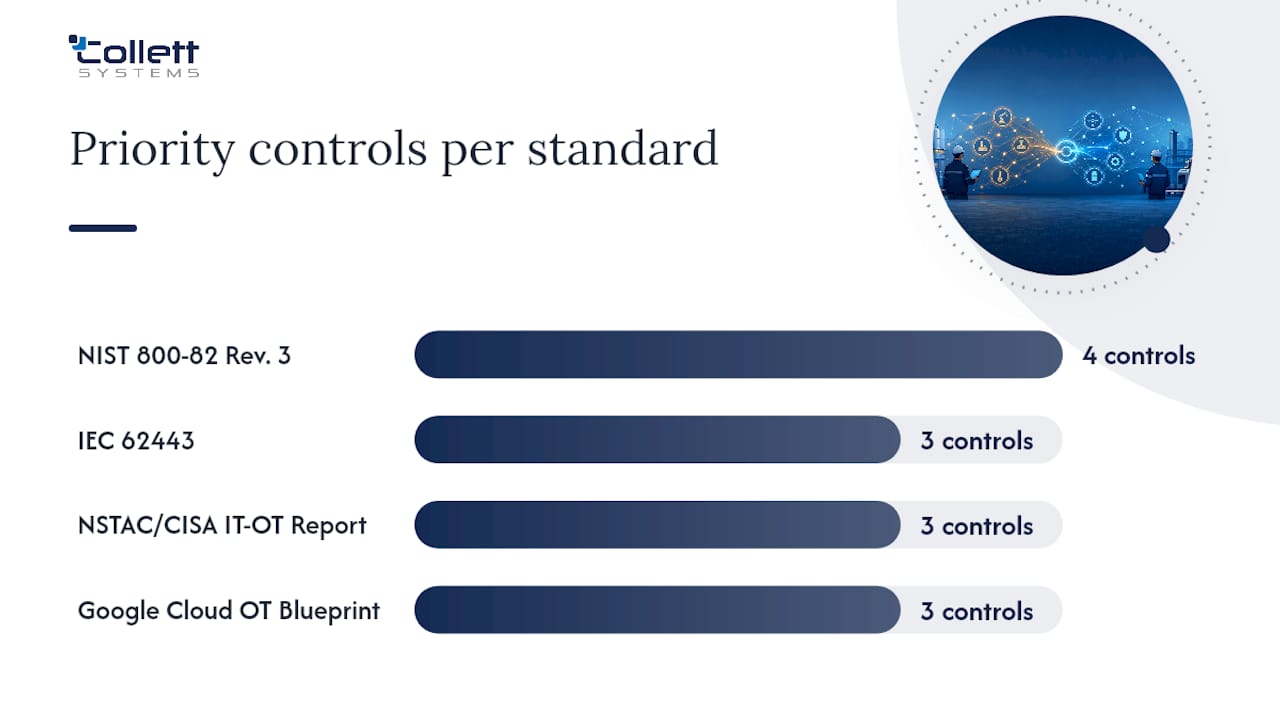
| Standard / Report | Key Controls to Prioritize First |
|---|---|
| NIST 800-82 Rev. 3 | Passive asset discovery, network segmentation, jump servers, OT-specific incident response |
| IEC 62443 | Zone-and-conduit architecture, security levels (SL-1 baseline for all OT assets), supply-chain requirements |
| NSTAC/CISA IT-OT Report | OT procurement language, zero-trust extension into OT where feasible, funding for OT security programs |
| Google Cloud OT Blueprint | OT-specific DMZ, encrypted unidirectional data flows, hybrid approaches for air-gapped systems |
NIST 800-82 Rev. 3 is the U.S. government's primary guide for industrial control system security. Its core architecture recommendations, passive discovery, network segmentation, and authenticated remote access, map directly to Phases 1 and 2 of the roadmap above. IEC 62443 provides the zone-and-conduit vocabulary that procurement teams can use to specify security requirements for new OT equipment purchases.
The NSTAC/CISA report is particularly direct about the organizational dimension: connecting OT to IT increases OT exposure to IT-style threats, and the report recommends extending zero-trust guidance into OT environments where feasible, alongside OT-specific procurement language. The report also identifies lack of investment as the largest impediment to securing converged systems, which is a direct argument for treating OT security as a budget line, not an afterthought.
For manufacturers moving OT data to cloud analytics, the Google Cloud OT security blueprint provides an operational checklist that maps cloud adoption patterns to the IEC 62443 and NIST 800-82 controls above. Its hybrid-cloud guidance is particularly relevant for manufacturers with air-gapped OT systems that cannot connect directly to public cloud services.
The practical implication: use IEC 62443 and NIST 800-82 as the architecture vocabulary in your RFPs and vendor contracts. Require vendors to map their products to specific security levels and zone-and-conduit requirements. That language gives your procurement team objective evaluation criteria and gives vendors a clear target.
Collett Systems LLC helps manufacturers execute IT/OT convergence securely
Manufacturers in Southeastern Wisconsin do not need a theory of IT/OT convergence. They need a partner who shows up, knows the environment, and keeps production running while the program builds.
Collett Systems LLC works directly with manufacturers across the region to deliver the specific capabilities an IT/OT program requires: passive OT asset discovery, segmented DMZ deployments, 24/7 monitoring, and managed cybersecurity that covers both the IT and OT sides of a converged environment. Fixed per-user pricing means no surprise invoices when a pilot expands to a second production line. Our team brings the OT-aware security architecture and the IT infrastructure management together under one contract, so your operations team is not caught between two vendors pointing at each other when something breaks.
The right starting point is a paid IT and Security Assessment: a documented baseline of your current environment, your OT asset inventory gaps, and a prioritized roadmap aligned to NIST 800-82 and IEC 62443. Schedule your assessment and get a clear picture of where you stand before committing to a full convergence program.
What I'd tell every plant manager starting an IT/OT program today
The single most common mistake I see is treating IT/OT convergence as an IT project. It is not. It is an operations project that IT enables. That distinction changes everything about how you staff it, how you sequence it, and how you measure success.
Visibility comes first, always. You cannot make good decisions about what to connect, segment, or monitor until you know exactly what is on your OT network. That passive asset discovery phase is not a checkbox; it is the foundation every subsequent decision rests on. Skip it and you will spend the next 18 months discovering devices you did not know existed, usually after something goes wrong.
Pilot before you scale. A 90-day read-only historian mirror on one production line will teach you more about your environment than any vendor briefing. It will also give your OT team the evidence they need to trust the program, and that trust is harder to rebuild than any technical architecture.
Segmentation is not optional and it is not expensive relative to the alternative. A ransomware event that crosses from IT to OT does not just cost you data; it costs you production, customer relationships, and in some industries, safety. The zone-and-conduit architecture that IEC 62443 describes is the right model, and it is achievable in phases.
If you are a manufacturer in Wisconsin and you want a straight answer about where your environment stands, schedule an assessment with our team. No sales theater, just a documented baseline and a prioritized roadmap you can act on.
Sources
The sources below formed the foundation of this guide. Each one is worth reading directly for the depth it provides on specific topics.