Most published estimates put a consultant-led IT security assessment for a company under 100 employees somewhere between $6,000 and $16,000, and the price you pay is set by scope: how many users, sites, systems and compliance rules the assessment has to cover. A cheap scan and a full risk assessment are different products with the same name. If you are a manufacturer, law firm, dental practice or financial firm in Wisconsin, the question to ask is not "what is the average?" but "what will I hold in my hands at the end, and who fixes what it finds?" Our IT & Security Assessment is built around that second question.
TL;DR
- One 2026 estimate puts a consultant-led risk assessment for a small business (under 100 employees, one or two sites) at $6K to $16K, with technical testing adding roughly $5K to $15K.
- Scope drives price: users, locations, cloud services, regulated data and whether testing is included.
- Vulnerability scans cost far less than risk assessments, but they answer a narrower question.
- Financial firms, dental practices and law firms handle data that rules like the FTC Safeguards Rule and HIPAA expect you to assess in writing.
- A data-flow map is the cheapest way to shrink the bill, because consultants bill by the hour for discovery.
Table of Contents
- What an IT security assessment actually includes
- What it costs in the U.S.
- Five things that move the price
- Three Wisconsin examples
- How to map your data flows before the assessment
- How to compare proposals
- Why the assessment should connect to ongoing IT
- Start with the assessment
- FAQ
- Sources
What an IT security assessment actually includes
The phrase covers several different jobs. Ask any provider to say which of these it means:
- Vulnerability assessment: automated scanning of networks, servers or applications for known weaknesses. It produces a list of findings.
- Penetration test: a person tries to break in, to show what an attacker could actually reach.
- Risk assessment: an inventory of what you have, a review of threats and weaknesses, and a ranking of risks by likelihood and impact. This is the one regulators generally mean.
- Compliance or gap assessment: your controls measured against a specific standard, such as HIPAA, the FTC Safeguards Rule or NIST 800-171 for defense suppliers.
- Cloud or network assessment: a narrower review of one environment, such as Microsoft 365 or the office network.
People who search "network assessment cost" or "IT assessment cost" usually mean the first or third item. A network assessment is a slice of a full IT assessment: it looks at firewalls, switches, Wi-Fi and segmentation but not at your people, vendors or paperwork.
What it costs in the U.S.
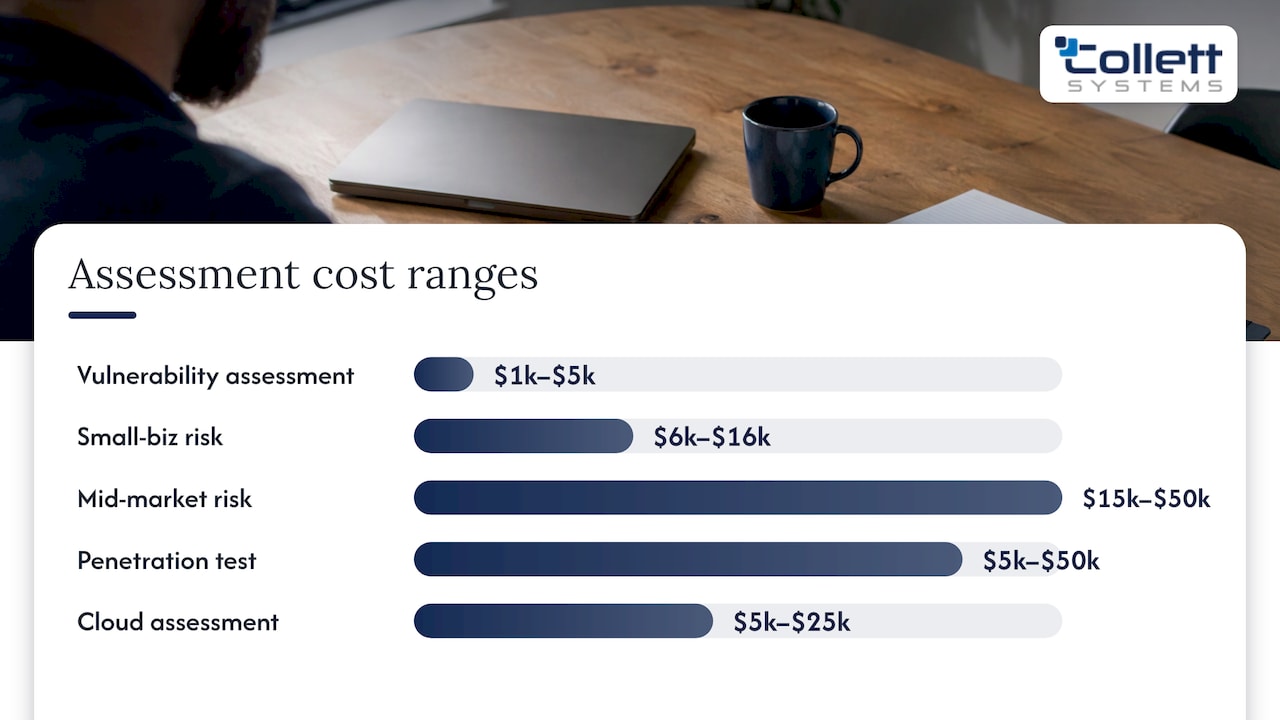
Public pricing is scattered, and the figures below are published estimates, not quotes. They are useful for sanity-checking a proposal. The SecurityBudget guide, updated November 2026, uses a blended consultant rate of $150 to $200 an hour.
| Type of work | Typical U.S. range |
|---|---|
| Vulnerability assessment | $1,000 to $5,000 |
| Risk assessment, small business (under 100 staff, 1 to 2 sites) | $6,000 to $16,000 |
| Risk assessment, mid-market | $15,000 to $50,000 |
| Penetration test | $5,000 to $50,000 (about $18,000 typical) |
| Cloud security assessment | $5,000 to $25,000 per cloud provider |
| HIPAA risk assessment with a consultant | $5,000 to $15,000+ |
The small-business figure assumes 40 to 80 consultant hours. That is the useful part: the price is mostly hours, and hours depend on how much the consultant has to discover versus how much you can hand over.
Very low numbers you may see online, such as a $199 "quick audit," describe automated scans of a single website or app. They do not cover a 40-person office with a shop floor, a file server and a line-of-business application.
We do not publish a price for our assessment. It is a paid, upfront engagement, and the scope of your environment shapes it, so the practical step is to talk to us about the assessment.
Five things that move the price
1. Headcount and endpoints. Every laptop, workstation, server and phone is something to inventory and check. Fifteen users and eighty users are different jobs.
2. Number of locations. A plant, a warehouse and an office each have their own network, physical controls and local equipment.
3. Regulated data. If you hold patient records, client files or customer financial information, the assessment has to map to a rule and produce documentation an auditor will accept. The FTC's Safeguards Rule guide says a covered business's risk assessment must be written and include criteria for evaluating risks. HHS says the HIPAA Security Rule requires administrative, physical and technical safeguards for electronic patient information.
4. Testing depth. Adding a penetration test is the largest single jump, roughly $5,000 to $15,000 more for a small business in the estimate above. Retailers who sell online will recognize the logic in: the more customer-facing systems you run, the more there is to test.
5. Your documentation. If the consultant must reconstruct your systems from scratch, you pay for it by the hour. If you arrive with an inventory and a diagram, discovery shrinks.
Three Wisconsin examples
These are illustrations of how scope reads, not quotes.
A 35-person machine shop. One site, a shop-floor network, a few CNC controllers, a file server with customer drawings and a cloud email tenant. The risk is downtime and stolen designs. A risk assessment that includes the plant network sits in the small-business band. Whether the shop-floor equipment is in scope should be stated in writing.

A five-dentist practice. Patient records are protected health information, so the assessment has to line up with HIPAA. Read more on our healthcare IT and HIPAA page. The scope question is which imaging, practice management and billing systems are covered.
A 20-person law or financial firm. Client data and email are the core. Financial firms covered by the Safeguards Rule must also report certain incidents: the FTC's rule requires notice within 30 days of discovering unauthorized acquisition of unencrypted customer information involving at least 500 consumers. An assessment should show you how you would detect and report that.
How to map your data flows before the assessment
Data mapping is the step that most reduces hours, and it is also what regulators expect. NIST's small-business guidance advises starting with a simple asset inventory and a network diagram showing how data moves between assets. Here is the routine.
- List what you have. Computers, servers, phones, cloud services, line-of-business software and the vendors that run any of it. NIST's CSF 2.0 guide says to include supplier-provided services and personal devices. Our 90-day IT asset inventory roadmap walks through building the list.
- Record the details per asset. Owner, location, what kind of data it holds and how sensitive it is, what happens if it is compromised, whether multi-factor authentication is on, and who can recover the account.
- Follow each type of data through its life. Where does it enter (a web form, an email, a scanned document, a machine), where is it processed and stored, who or what receives it, and when is it deleted? NIST recommends mapping from collection to disposal.
- Draw it. A simple diagram is enough: boxes for systems, arrows for data moving between them, including remote access and outside vendors.
- Mark the sensitive paths. Patient records, client files, customer financial data and design files get highlighted. Those are the arrows an assessment examines first.
- Keep it current. The proposed HIPAA Security Rule update, described in HHS's fact sheet, would require a technology asset inventory and network map updated at least every 12 months. HHS notes the current rule stays in effect while rulemaking continues.
Where this goes wrong: the map is drawn once from memory and never matches reality. Shadow software, a forgotten remote-access tool and a vendor with a copy of your data are the usual gaps. When we run an assessment, a documented map is something we can check against what is actually on your network.
How to compare proposals
When you have two or three quotes, line them up on the same questions:
- Is it a scan, a risk assessment, a test, or a combination?
- How many users, devices, locations and cloud services are in scope?
- Which rule or framework is it measured against?
- Do you get a written, ranked list of risks, with a plan to fix them?
- Who does the fixing, and is that cost separate?
The last question is the one that decides whether the money is well spent. An assessment is a snapshot. Your score, prioritize, fix checklist is only worth the effort if someone owns the fixes afterward.
Why the assessment should connect to ongoing IT
A stand-alone report can cost five figures and then sit in a drawer, because the findings, such as patching gaps, missing MFA and untested backups, are ongoing work. Our approach is to treat IT as infrastructure that someone continuously owns: fixed cost per user, 24/7 monitoring, proactive support, security management, backup and disaster recovery, and compliance documentation. If you want to see where you stand before any conversation, the free IT risk score takes about a minute, and our cybersecurity risk assessment services page describes the larger engagement.
Our view
We build our business on the idea that IT is infrastructure, not an expense you absorb whenever something breaks. That shapes how we think about assessment cost. The number on the proposal matters less than whether the findings turn into a fixed, documented set of controls that someone keeps running.
That is why we run a standardized, fully-loaded stack for every client with fixed per-user pricing. Strategic planning, audit readiness and automation improvements are included, not sold as add-ons. For a manufacturer, a dental practice or a financial firm, an assessment is the first page of that relationship: it tells us and you where the exposure is, and then we own closing it. More than 150 local organizations work with us on that basis.
If you take one thing from this article, take the data map. Know what you have and where your data moves, and every assessment, ours or anyone's, gets sharper.
Dustin Collett
Start with the assessment
If you run a manufacturing, legal, dental or financial business in Southeastern Wisconsin and want a written picture of your risk and a plan to close it, the IT & Security Assessment is where we begin. It is a paid engagement scoped to your users, sites and regulated data, and it leads naturally into managed IT services when you want us to own the fixes.
Book the IT & Security Assessment and bring your inventory and diagram if you have them. If you already have an internal IT person, co-managed IT is built to work alongside them.
FAQ
How much does a small business IT security assessment cost?
One 2026 U.S. estimate puts a consultant-led risk assessment for a business under 100 employees at $6,000 to $16,000, based on 40 to 80 hours of work. Technical testing is extra. Your actual cost depends on users, locations and regulated data.
Is a network assessment cheaper than a full IT assessment?
Usually, yes. A network assessment looks at firewalls, switches, Wi-Fi and segmentation, while a full assessment also covers accounts, cloud services, vendors, backups and written policies. Vulnerability scanning of a network is typically quoted around $1,000 to $5,000.
Does my business have to do a security assessment?
It depends on the data you hold. Financial firms under the FTC Safeguards Rule must have a written risk assessment, and HIPAA-covered practices must safeguard electronic patient information under the Security Rule. A law firm or manufacturer may face contract or client requirements instead. For your own obligations, ask your attorney or compliance adviser, and we can document the technical side.
How often should we repeat an assessment?
At least yearly, and after major changes such as a new location, new software handling sensitive data or a new vendor. The proposed HIPAA update points to a 12-month cycle for inventory and network maps.
Sources
- Cybersecurity Risk Assessment Cost 2026
- FTC Safeguards Rule: What Your Business Needs to Know
- The Security Rule, HHS
- Standards for Safeguarding Customer Information, FTC
- Small Business Cybersecurity: Non-Employer Firms, NIST
- NIST Cybersecurity Framework 2.0 Resource & Overview Guide
- HIPAA Security Rule NPRM fact sheet, HHS