Shadow IT Discovery: SMB Guide to Find, Assess & Govern

Shadow IT discovery is the continuous program of locating, inventorying, and risk-scoring every unmanaged SaaS application, cloud service, browser extension, and hardware asset that processes corporate data outside IT’s oversight. The program objective is straightforward: produce a prioritized, living inventory that reduces security exposure, compliance liability, and license waste before any of those risks materialize into an incident.

The single best first action is to run an identity-provider (IdP/SSO) log scan in parallel with a seven-day network traffic and proxy log collection. IdP logs surface authenticated applications quickly, often within hours, because every OAuth grant and federated login leaves a traceable record. Network and DNS logs catch the rest: non-federated apps, API-driven integrations, and browser-based tools that never touch your SSO. Together, those two sources produce a preliminary inventory that is far more complete than any survey or manual audit.
First 72-hour action checklist:
-
Export IdP/SSO audit logs for the past 30 days and query for OAuth grants and third-party app authorizations.
-
Collect seven days of DNS query logs and proxy or firewall traffic logs; filter for cloud-service destinations.
-
Pull corporate credit card and expense report data for the past 90 days; flag SaaS subscription line items.
-
Request a browser extension inventory from your endpoint management platform or MDM where feasible.
-
Document every discovered asset in a shared spreadsheet or ITSM ticket queue, even before scoring begins.
CISA’s guidance on zero-trust architecture and the Cloud Security Alliance’s cloud-control frameworks both treat asset visibility as a foundational prerequisite for any security program. Collettsystems applies this same principle for SMB clients in Southeastern Wisconsin, running structured discovery as the entry point to every managed IT engagement.
Table of Contents
-
How do you assess discovered apps and prioritize remediation?
-
Remediation and governance: from discovery to enforced policy
-
Which tools and deployment patterns fit your organization’s size?
-
How a managed IT provider accelerates shadow IT discovery for SMBs
-
Collettsystems offers a structured path from discovery to governance
What exactly counts as shadow IT today?
Shadow IT, in operational terms, is any hardware, software, cloud service, or browser extension that processes, stores, or transmits corporate data without explicit IT approval or active management. The definition has expanded considerably as cloud adoption has accelerated.
Assets that fall inside a discovery program’s scope include:
-
SaaS applications accessed via browser or mobile app, from project management tools to niche vertical software.
-
Browser extensions with permissions to read page content, access clipboard data, or communicate with external servers.
-
Unmanaged cloud storage such as personal Dropbox, Google Drive, or OneDrive accounts used for business files.
-
OAuth-connected integrations where an employee grants a third-party app persistent access to a corporate Google Workspace or Microsoft 365 account.
-
Shadow AI tools accessed via public web interfaces or direct API calls, including public large language models where employees paste internal data into prompts.
-
Employee-owned devices running business workloads outside mobile device management (MDM) enrollment.
-
Webhook and API key configurations that connect sanctioned platforms to unsanctioned external services.
Shadow AI deserves particular attention in 2026. When an employee submits a prompt containing customer PII or proprietary product data to a public LLM, that data leaves the organization’s control entirely. Traditional discovery methods often miss this class of exposure because the traffic looks like ordinary HTTPS web browsing. Browser-level telemetry and DLP rules targeting known AI API endpoints are required to close that gap.
What discovery should not attempt to collect: personal communications, non-work browsing unrelated to corporate data, or any content that falls outside the scope of your acceptable-use policy. Defining those boundaries in writing before deploying any telemetry is both a legal requirement and a prerequisite for employee trust.
Why shadow IT is a serious business risk
The risk is not theoretical. Unmanaged applications create three distinct categories of exposure that compound each other when left unaddressed.

Security and data exposure. An employee who syncs a project folder to a personal cloud storage account has effectively moved sensitive data outside every data-loss prevention (DLP) control the organization has deployed. OAuth grants are particularly dangerous: a single “Sign in with Google” authorization can give a third-party app persistent read/write access to email, calendar, and Drive, with no expiration date and no IT visibility. Unauthorized API keys embedded in automation scripts create similar persistent-access risks, often surviving long after the employee who created them has left the organization.
Compliance violations. Organizations subject to HIPAA, PCI DSS, or SOX face direct regulatory exposure when protected data flows through unapproved systems. A healthcare SMB whose billing coordinator uses an unsanctioned scheduling tool to share patient appointment data has potentially created a HIPAA breach scenario, regardless of intent. GDPR implications arise in US-based workflows that involve EU resident data, and the FTC’s data-security enforcement posture has made “reasonable security” a live compliance question for companies of all sizes.
License and financial waste. Duplicate SaaS subscriptions are common in organizations without a managed software asset inventory. Teams independently purchase overlapping tools, paying for seats that go unused or that duplicate functionality already available in a sanctioned platform. Automated discovery combined with scheduled application rationalization reduces this waste by surfacing redundant subscriptions and enabling consolidation decisions.
The risk profile differs meaningfully between SMBs and larger enterprises. A mid-market company with a dedicated security operations center can detect and contain an OAuth-related incident within hours. An SMB with a two-person IT team may not discover the same incident for weeks, by which point data exfiltration has already occurred and regulatory notification timelines are running. That asymmetry makes proactive discovery proportionally more valuable for smaller organizations, not less.
One legal consideration applies to every organization: employee monitoring must align with your acceptable-use policy and applicable state privacy laws. Before deploying endpoint agents or browser telemetry, document the monitoring scope, obtain appropriate legal review, and communicate the policy to employees in plain language.
How do you discover shadow IT across your environment?
No single technique is comprehensive. Effective programs layer at least three orthogonal methods, because each one has documented blind spots that leave portions of the SaaS estate invisible when used alone. The table below maps each method to what it finds, where it fails, and what it costs to deploy.
| Method | What it detects | Key blind spots | Required data sources | Deployment effort |
|---|---|---|---|---|
| Network traffic / proxy logs | Cloud destinations, API calls, DNS lookups | Off-VPN traffic, encrypted SNI, mobile data | Firewall, proxy, DNS resolver logs | Low to medium |
| IdP / SSO audit logs | OAuth grants, federated app logins, token issuance | Non-SSO apps, direct-login SaaS | Azure AD / Okta / Google Workspace audit logs | Low |
| Expense / procurement mining | Paid SaaS subscriptions, credit card charges | Free-tier apps, personal card spend | Expense reports, AP data, corporate card feeds | Low to medium |
| Endpoint / browser agents | Installed apps, browser extensions, local data flows | Unmanaged devices, BYOD | MDM, managed browser policy, lightweight agent | Medium |
| OAuth / grant audits | Persistent third-party access tokens | Revoked-but-reinstalled grants | Google Workspace admin, Microsoft 365 admin center | Low |
| Email / invoice scanning | SaaS trial confirmations, billing receipts | Encrypted inboxes, personal email | IT-managed mailboxes, shared inboxes | Low |
| CASB / MSSP integrations | Broad cloud traffic, DLP policy enforcement, risk scoring | Cost, complexity, deployment time | Proxy or API integration, agent deployment | High |
Implementation notes by method:
-
Network/proxy logs: Query for cloud-service categories and unknown destinations. The critical pitfall is off-VPN traffic: remote employees on home networks bypass on-premises proxies entirely, leaving a significant blind spot unless you deploy a cloud-delivered DNS security layer.
-
IdP logs: Pull OAuth consent grants and filter for third-party applications. In Microsoft Entra ID, the “Application” audit category surfaces these events directly. In Google Workspace, the Admin SDK Reports API provides equivalent data.
-
Expense mining: A lookback on corporate card data typically surfaces a substantial portion of paid SaaS subscriptions. Cross-reference against your approved software list to identify gaps.
-
Endpoint/browser agents: For SMBs, browser-based detection using managed extensions or lightweight endpoint agents is a cost-effective path to visibility without the complexity and cost of an enterprise CASB deployment.
-
OAuth audits: Run a full grant inventory quarterly. Pay particular attention to grants with broad scopes (mail.read, files.readwrite.all) issued to apps outside your known vendor list.
-
CASB: Microsoft Defender for Cloud Apps ingests firewall and proxy logs, integrates with Microsoft Entra, and provides a risk-scored app catalog covering tens of thousands of applications. It is the most complete single-tool option for organizations already in the Microsoft ecosystem.
Recommended sequencing: Start with IdP logs and network/DNS logs in week one. Layer in expense mining and endpoint/browser telemetry in weeks two and three. Add OAuth grant audits in week four. Introduce CASB or MSSP-level integration once the foundational inventory is stable and you have the budget to support it.
Pro Tip: Route all discovery telemetry directly into your SIEM or asset inventory from day one. A shadow IT program that lives in spreadsheets becomes unmanageable within 90 days and cannot feed incident response or compliance reporting.
How do you assess discovered apps and prioritize remediation?
A raw inventory of 200 discovered applications is not actionable. Risk scoring converts that list into a prioritized queue. The dimensions below give you a reproducible framework you can adapt to your organization’s risk tolerance.
Risk-scoring dimensions:
-
Data sensitivity: Does the app process PII, PHI, financial records, or intellectual property? Score higher for regulated data categories.
-
OAuth scopes and persistent access: Broad scopes (full mailbox access, file system write) with no expiration date represent elevated risk regardless of the app’s reputation.
-
User count and growth trend: An app used by three people is a different risk profile than one used by 80 and growing. Rapid adoption without IT awareness is itself a signal.
-
Integration and automation risk: Apps connected via API keys or webhooks to core business systems (CRM, ERP, HR) can exfiltrate or corrupt data at scale.
-
Vendor maturity and compliance posture: Does the vendor publish a SOC 2 Type II report? Do they have a published data processing agreement? Absence of either is a risk factor.
-
Data residency: Where does the vendor store and process data? US-based SMBs with HIPAA or ITAR obligations need to know.
-
Blast radius: If this app were compromised or the vendor experienced a breach, how many users, systems, and data categories would be affected?
Triage decision matrix:
-
Immediate block signals: Apps with no identifiable vendor, apps known to be associated with malware or data harvesting, apps with broad OAuth scopes and no business justification, and apps storing regulated data with no DPA or BAA.
-
Fast-track approve signals: Apps from established vendors with SOC 2 Type II certification, limited data scope, low user count, and a clear business use case that maps to an existing approved category.
-
Conditional-use signals: Apps with moderate data access, a legitimate business need, but gaps in vendor compliance documentation. Require a signed DPA, restrict to non-regulated data, and set a 90-day review.
-
Monitor/tolerate signals: Low-risk productivity tools with no data-handling concerns, used by a small number of employees, with no integration to core systems.
A risk-tiered approach with fast-track approval SLAs reduces friction and keeps business units from bypassing IT. The recommended SLA is 3–5 business days for low-risk fast-track decisions, with a documented 30-day remediation or migration plan for mid-risk conditional items.
Document every triage decision in your ITSM platform or SaaS inventory tool, including the rationale, the approver, and the next review date. That documentation is what transforms a discovery exercise into an auditable governance record.
Remediation and governance: from discovery to enforced policy
Discovery without remediation is an audit exercise. The playbook below converts findings into enforced controls and a repeatable governance cycle.
Short-term containment (days 1–14):
-
Block Tier 4 (immediate-block) apps at the DNS or proxy layer. Do not wait for a formal review cycle.
-
Disable or revoke high-risk OAuth tokens identified in the grant audit. In Microsoft 365, this is a single admin action per grant; in Google Workspace, use the Admin Console’s “Connected apps” management panel.
-
Apply conditional access policies to restrict high-risk app categories for users who handle regulated data.
-
Isolate critical data flows: if a discovered app has been syncing files from a regulated SharePoint library, suspend that sync and notify the data owner.
Medium-term actions (weeks 2–8):
-
Enroll fast-tracked apps into SSO so authentication is centrally managed and access can be revoked instantly.
-
Apply DLP policies to newly onboarded apps where the platform supports it.
-
Onboard the vendor into your procurement and contract management process, including a signed DPA where required.
-
Update your asset inventory to reflect the new approved status and associated controls.
Long-term policy elements:
-
Define four risk tiers with clear criteria: Approved, Tolerated (conditional), Conditional (restricted use), and Blocked.
-
Publish approval SLAs so business units know what to expect when they submit a new tool request.
-
Establish a quarterly recertification cadence: every app in the inventory is reviewed, and approvals that no longer have a business owner are revoked.
-
Assign roles explicitly: IT owns the technical controls, security owns the risk assessment, procurement owns the vendor relationship, and a named business owner is accountable for each approved application.
-
Include monitoring notice language in your acceptable-use policy that describes what telemetry is collected and why.
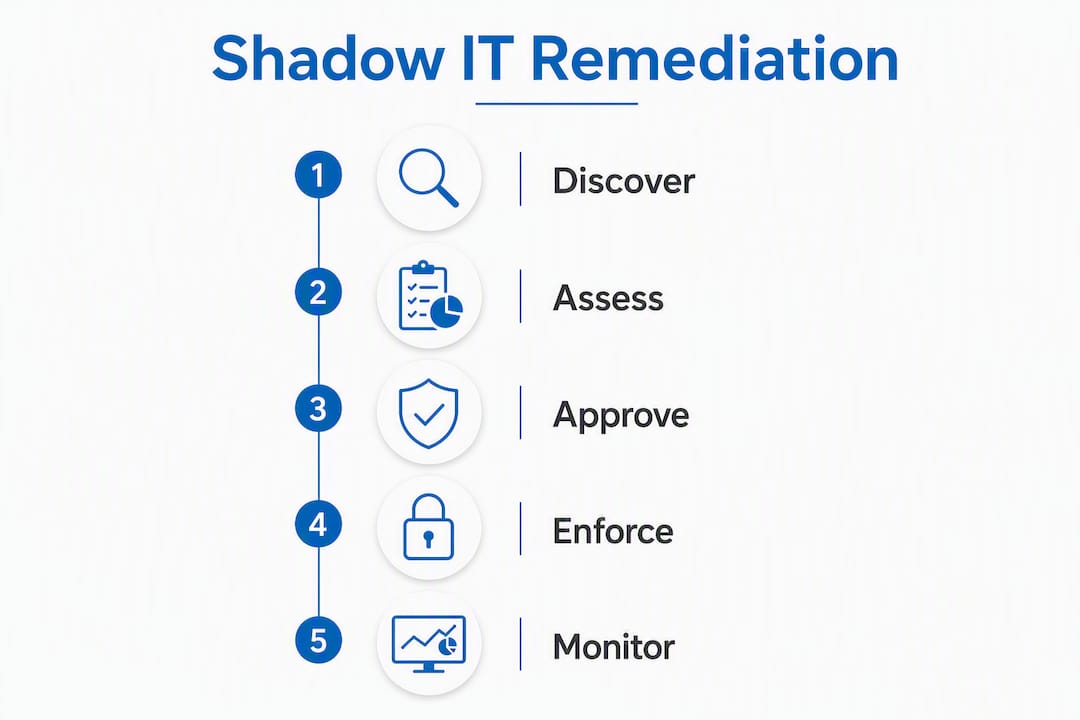
Step-by-step governance playbook:
-
Run discovery using layered telemetry (IdP + network + expense + endpoint).
-
Score each discovered asset against the risk dimensions above.
-
Apply the triage matrix: block, fast-track, conditional, or monitor.
-
For fast-tracked apps, complete SSO enrollment and DLP policy application within the SLA window.
-
For conditional apps, issue a documented conditional-use agreement and set a 90-day review.
-
Feed all decisions into ITSM and update the asset inventory.
-
Run continuous monitoring and quarterly recertification to catch new apps and changes in vendor posture.
Continuous discovery integrated into incident response and asset inventory prevents shadow IT from becoming an unmanaged long-term liability. A one-time audit decays within weeks as employees adopt new tools; only a continuous program maintains meaningful visibility.
Pro Tip: Make the sanctioned path faster than the workaround. If your approval process takes three weeks, employees will not use it. A 5-business-day fast-track target for low-risk tools is achievable and dramatically reduces the incentive to bypass IT.
Which tools and deployment patterns fit your organization’s size?
Tool selection depends on three variables: the size of your environment, the telemetry sources already available, and the staff capacity to operate the tooling. The table below maps organization size to practical tool class recommendations.
| Org size | Recommended tool classes | Expected time-to-value | Key data sources | Cost shape |
|---|---|---|---|---|
| Small (few users) | IdP audit logs + DNS/proxy exports + manual expense audit | 1–2 weeks | SSO platform, DNS resolver, expense reports | Minimal; largely staff time |
| SMB (mid-sized users) | Above + lightweight endpoint/browser agent + OAuth audit tooling | 2–4 weeks | MDM, managed browser, admin APIs | Low to moderate monthly cost |
| Mid-market / enterprise | Above + CASB or MSSP integration + SIEM normalization | 4–8 weeks | Full telemetry stack, SIEM, CASB API | Moderate to high; per-seat or platform licensing |
SMB quick-start path:
For organizations under 250 users without a dedicated security team, the most cost-effective starting point combines three elements. First, export IdP audit logs from your existing SSO platform (Microsoft Entra ID, Okta, or Google Workspace) — this costs nothing beyond staff time and surfaces OAuth grants immediately. Second, enable DNS query logging on your existing firewall or deploy a cloud-delivered DNS security layer, which adds cloud-service visibility for a modest monthly cost. Third, run a 90-day expense report audit manually; this typically requires four to eight hours of analyst time and surfaces the majority of paid SaaS subscriptions.
SMBs can achieve high visibility by prioritizing IdP logs plus lightweight endpoint or browser telemetry rather than immediately committing to an enterprise CASB. That sequencing keeps initial costs low while building the foundational inventory needed to justify further investment.
Tool class pros and cons:
-
IdP/SSO analytics: Fast to deploy, high signal quality for authenticated apps. Does not catch non-SSO tools or free-tier apps accessed with personal credentials.
-
SIEM/log analytics: Centralizes telemetry and enables correlation. Requires log normalization work and ongoing rule maintenance.
-
DNS/proxy/CASB: Broad coverage including non-authenticated traffic. CASB adds risk scoring and DLP. Higher cost and deployment complexity.
-
Endpoint/browser agents: Catches installed software and browser extensions on managed devices. Blind to BYOD and unmanaged endpoints.
-
Expense/subscription management: High accuracy for paid tools. Misses free-tier and personal-card spend.
-
OAuth governance tooling: Precise visibility into persistent access grants. Requires admin API access to each platform.
Vendor-agnostic selection criteria checklist:
-
Does the tool ingest the data sources you already have (IdP, DNS, endpoint)?
-
Can it export discovered app data to your ITSM or SIEM via API?
-
Does it provide a risk score or app catalog, or does scoring require manual effort?
-
Does it include privacy controls that limit collection to work-related activity?
-
What is the deployment timeline for a team of your size, and what staff skills are required?
How a managed IT provider accelerates shadow IT discovery for SMBs
For an SMB without a dedicated security analyst, the discovery program described above is achievable but time-intensive. A managed IT provider compresses the timeline by bringing pre-built telemetry integrations, a structured assessment methodology, and the staff capacity to run the program continuously.
Collettsystems runs shadow IT discovery as part of its managed IT and security assessment engagements for SMB clients in Southeastern Wisconsin. The service flow follows five phases:
-
Phase 1 — Discovery (weeks 1–2): Deploy IdP log collection, DNS/proxy log exports, and expense mining. Where the client has an endpoint management platform, add browser extension inventory. Produce a preliminary app inventory.
-
Phase 2 — Risk scoring (week 3): Apply the risk-scoring framework above to every discovered asset. Categorize into the four tiers and flag immediate-block items for same-day action.
-
Phase 3 — Remediation (weeks 3–6): Block Tier 4 apps at DNS/proxy. Revoke high-risk OAuth tokens. Begin SSO enrollment for fast-tracked apps. Issue conditional-use agreements for mid-risk items.
-
Phase 4 — Onboarding and governance (weeks 4–8): Complete SSO and DLP enrollment for approved apps. Update the asset inventory. Deliver a documented audit trail suitable for compliance review.
-
Phase 5 — Continuous monitoring: Transition to ongoing monthly discovery snapshots, quarterly recertification, and 24/7 monitoring for new app adoption signals.
Typical client outcomes from an initial engagement include a measurable reduction in unmanaged application count, reclaimed license spend from duplicate or unused SaaS subscriptions, enforced SSO and MFA across the approved app portfolio, a documented audit trail for HIPAA or SOC 2 compliance reviews, and a shorter mean time to remediate newly discovered apps as the governance process matures.
Collettsystems delivers this through its fixed per-user pricing model, which means clients know the cost of ongoing managed discovery before the engagement begins. The 24/7 monitoring capability ensures that new shadow IT adoption is flagged between scheduled review cycles, not discovered months later during an annual audit.
What metrics tell you the program is working?
A shadow IT program without measurement is a project, not a program. The KPIs below give you a quantitative basis for reporting progress to leadership and for identifying where the program needs adjustment.
Recommended KPIs:
-
Percentage reduction in unmanaged apps: Baseline at program launch; measure monthly. A well-run program typically shows significant reduction within the first 90 days as fast-track approvals and blocks are processed.
-
Fast-track approvals completed within SLA: Tracks whether the 3–5 business-day target is being met. Slippage here predicts increased shadow IT adoption.
-
Time-to-remediate high-risk (Tier 4) apps: Should be measured in hours, not days. Any Tier 4 app that remains active for more than 24 hours after identification represents unacceptable exposure.
-
License cost reclaimed: Dollar value of duplicate or unused SaaS subscriptions identified and cancelled. This metric resonates with finance and executive stakeholders.
-
OAuth tokens revoked: Tracks the reduction in persistent third-party access grants. A declining count indicates the grant audit process is working.
-
Incidents prevented or contained: Where your SIEM or incident response platform can attribute a near-miss to a shadow IT control, document it. This is the most persuasive metric for continued investment.
Reporting cadence:
-
Weekly (first 90 days): Discovery snapshots showing new apps identified, triage decisions made, and blocks applied. Keeps the team accountable during the high-activity launch phase.
-
Monthly: Executive summary covering KPI trends, license savings, and open remediation items. One page, focused on business outcomes rather than technical detail.
-
Quarterly: Full app inventory recertification, policy review, and program health assessment. This is the governance checkpoint where conditional approvals are renewed or revoked.
90-day milestone targets:
-
Days 1–30: Baseline inventory complete, Tier 4 apps blocked, fast-track queue established.
-
Days 31–60: SSO enrollment complete for fast-tracked apps, expense audit findings actioned, OAuth grant inventory published.
-
Days 61–90: First monthly executive summary delivered, quarterly recertification process documented, continuous monitoring operational.
Beyond 90 days, the program shifts from remediation-heavy to maintenance mode, with discovery running continuously and the governance process handling new app requests through the established fast-track workflow.
Key Takeaways
Effective shadow IT discovery requires layering at least three orthogonal detection methods, a risk-tiered triage framework, and a fast-track approval process that makes the sanctioned path faster than the workaround.
| Point | Details |
|---|---|
| Layer three detection methods | Combine IdP logs, network/DNS logs, and expense mining as your baseline; add endpoint agents and OAuth audits to close blind spots. |
| Fast-track approvals within 3–5 days | A slow approval process drives shadow IT adoption; a 3–5 business-day SLA for low-risk tools keeps employees from bypassing IT. |
| Risk-tier every discovered app | Score on data sensitivity, OAuth scope, user count, and vendor maturity; block Tier 4 apps within 24 hours of identification. |
| Measure reduction in unmanaged apps | Track the percentage of unmanaged apps monthly; this single metric most clearly shows program progress to leadership. |
| Collettsystems delivers managed discovery | Collettsystems runs structured shadow IT discovery for SMBs in Southeastern Wisconsin with fixed per-user pricing and 24/7 monitoring. |
The case for managed discovery over DIY
Shadow IT discovery is not a one-time project, and that distinction matters more than most security teams acknowledge at the outset. The tools and methods described throughout this guide are genuinely accessible to a capable IT team, but the operational reality for most SMBs is that the program competes with every other priority on the team’s plate. Discovery telemetry needs to be reviewed. Triage decisions need to be made and documented. OAuth grants need to be audited on a recurring schedule. When those tasks slip, the inventory decays and the program loses its value within a quarter.
The argument for a managed approach is not that SMBs lack the technical capability. It is that continuous programs require consistent execution, and consistent execution is difficult to sustain without dedicated capacity. A managed provider brings that capacity at a predictable cost, with pre-built integrations and a structured methodology that compresses the time from initial discovery to enforced governance. For organizations with fewer than 250 users and no dedicated security analyst, that time compression is often the difference between a program that delivers measurable outcomes and one that stalls after the initial audit.
The fast-track approval model is where managed discovery pays for itself most visibly. When a business unit needs a new tool and the approval process takes three weeks, they will not wait. When it takes three days, they will. That behavioral shift is what actually reduces shadow IT over time, not the blocking of individual applications.
For SMBs in Southeastern Wisconsin considering where to start, a structured IT and security assessment with Collettsystems is a practical first step.
Collettsystems offers a structured path from discovery to governance
Shadow IT discovery is most valuable when it leads directly to enforced controls, not just a longer spreadsheet. Collettsystems provides managed IT services for SMBs in West Bend and Southeastern Wisconsin built around exactly this outcome: a structured assessment that produces an actionable inventory, a risk-tiered remediation plan, and ongoing 24/7 monitoring to catch new shadow IT adoption between review cycles.
The paid IT and Security Assessment includes a full shadow IT inventory using layered telemetry (IdP, DNS, expense, and endpoint where available), risk scoring and triage across all discovered assets, a documented remediation plan with fast-track approvals and block recommendations, SSO enrollment support for approved applications, and a compliance-ready audit trail. Initial discovery and triage typically complete within two to six weeks. Ongoing managed monitoring runs continuously at a fixed per-user monthly cost, with no tiered service surprises.
If your organization has not run a structured discovery program, the assessment is the right starting point. Contact Collettsystems to schedule yours.
Authoritative sources and further reading
The references below support the methods and frameworks described in this guide. Each entry is labeled with its primary use case for implementation.
-
NIST SP 800-207: Zero Trust Architecture — Foundational framework for asset visibility and access control; use when designing the governance policy and conditional access controls.
-
Microsoft Defender for Cloud Apps: Shadow IT Discovery Tutorial — Step-by-step implementation guide for cloud discovery using firewall/proxy log ingestion and the Microsoft app risk catalog.
-
Cisco Umbrella: Shadow IT App Discovery — Reference for DNS-layer discovery and enforcement; useful for understanding cloud-service visibility and blocking workflows.
-
Adaptive Security: Shadow IT Discovery Guide — Comprehensive guide covering layered detection methods, shadow AI detection, and governance frameworks.
-
LeanIX: What Is Shadow IT? — Application rationalization and license management reference; use when building the expense mining and subscription consolidation workflow.
-
Decryption Digest: Shadow IT Discovery and Management — Practical guide covering DNS/proxy analysis, OAuth audits, employee surveys, and fast-track approval SLA recommendations.
-
Level.io: Shadow IT Discovery and Prevention for IT Teams — Reference for integrating continuous discovery into ITSM and incident response workflows.
-
LastPass Blog: Shadow IT Management — SMB-focused guidance on cost-effective discovery using browser-based detection and lightweight endpoint agents as an alternative to enterprise CASBs.