An incident response plan is a formally approved document that tells your team exactly what to do before, during, and after a cybersecurity incident, and it only works if senior leadership signs off on it and someone owns it year-round. This article gives you the frameworks, roles, templates, and testing cadence to build one that actually holds up when an alert fires at 2 a.m.
TL;DR:
- The incident response plan must explicitly define what constitutes an incident and cover scope, notification procedures, and roles approved by senior leadership.
- Building on frameworks like NIST or PICERL, the plan needs detailed playbooks, clear ownership, and pre-approved response actions tailored to tool-specific procedures.
- Regular testing through quarterly tabletop exercises and annual simulations improves detection, containment, and response times, with a focus on key KPIs like MTTD and MTTC.
- Retrospectives within two weeks of containment are essential to address process gaps, assign accountability, and update the plan based on lessons learned.
- External communication templates and legal contacts should be prepared in advance to ensure accurate, timely messaging and compliance with all breach notification laws.
Table of Contents
- What Does an Incident Response Plan Actually Cover?
- Which Framework Should You Build Your Plan On?
- Who Should Be on Your Incident Response Team?
- What Should Be in an Incident Response Plan Template?
- How Do You Turn the Plan Into Something People Actually Use?
- How Often Should You Test an Incident Response Plan?
- What Happens After an Incident Is Contained?
- What Should You Do in the First Two Hours of an Incident?
- How Does an Incident Response Plan Fit Into Business Continuity?
- How Do You Communicate With the Outside World During an Incident?
- What Legal Obligations Come With a Data Breach?
- Does Everyone in the Company Need Incident Response Training?
- How Do You Classify and Prioritize Incidents?
- What Other Metrics Show Your Incident Response Program Is Working?
- The Gap Between a Written Plan and a Working One
- How Collett Systems LLC Turns Your IR Plan Into an Operational Capability
- Authoritative Resources for Building Your Plan
- Sources
- FAQ
What Does an Incident Response Plan Actually Cover?
An incident response plan exists to limit damage, preserve evidence, and get you back to normal operations without guessing your way through it. The CISA IRP Basics factsheet describes it as a living document with assigned roles, defined responsibilities, and a recommended regular review cycle, not a PDF you write once and file away.
The first job of the plan is defining what counts as an "incident" in your environment. A failed login attempt is not the same animal as ransomware encrypting your file server, and your plan needs to say so explicitly. Scope should cover which systems, data types, and third parties fall under the plan, plus who gets notified at each severity level.
Before any of that matters operationally, the plan needs a signature. Senior leadership, whether that's your CEO, board, or a designated executive sponsor, has to formally acknowledge and approve the document. Without that approval, you have a technical runbook, not an incident response plan, and you'll find that distinction matters the moment legal or your cyber insurer asks who authorized it.
A solid plan delivers on three fronts:
- Damage limitation: predefined containment actions stop an incident from spreading while you investigate.
- Evidence preservation: documented chain-of-custody steps keep forensic data usable in court or for insurance claims.
- Regulatory readiness: notification timelines and reporting templates are drafted before you need them, not during a breach.
Every plan needs a named owner, usually someone in IT or security leadership, who is accountable for keeping it current between incidents.
Which Framework Should You Build Your Plan On?
You have two dominant choices, and most mature programs end up borrowing from both. The NIST SP 800-61 Computer Security Incident Handling Guide organizes incident response into four phases: Preparation, Detection and Analysis, Containment/Eradication/Recovery, and Post-Incident Activity. It's the framework most federal guidance and compliance auditors expect to see referenced by name.
SANS built a more granular, operationally focused alternative known as PICERL: Preparation, Identification, Containment, Eradication, Recovery, Lessons Learned. It splits NIST's middle phase into three distinct steps, which tends to help smaller teams because each phase maps cleanly to a specific playbook and a specific person's job.
Neither framework tells you exactly what to do when a specific alert fires. That's the gap playbooks fill. Here's how the phases map to what you actually need to have written down:
| Lifecycle phase | NIST equivalent | Artifacts and playbooks needed |
|---|---|---|
| Preparation | Preparation | Policy document, contact lists, tool access, retainer agreements |
| Identification | Detection and Analysis | Alert triage playbook, severity matrix, escalation criteria |
| Containment | Containment/Eradication/Recovery | Isolation runbooks, EDR quarantine steps, network segmentation |
| Eradication | Containment/Eradication/Recovery | Malware removal steps, credential resets, patch verification |
| Recovery | Containment/Eradication/Recovery | Restore-from-backup procedure, validation checklist, monitoring |
| Lessons Learned | Post-Incident Activity | Retrospective template, remediation tracker, plan revision log |
Pick one framework as your backbone and adopt PICERL's granularity for playbook design if you're a leaner team. What matters more than which acronym you choose is whether every phase has a named owner and a written procedure behind it.
Who Should Be on Your Incident Response Team?
Every incident response plan needs defined roles with defined authority, or you get five people making contradictory decisions during the worst hour of your week. Small and mid-sized organizations don't need a dozen dedicated specialists. They need clear ownership across five functions, even if some are covered by outside retainers.
- Incident Manager: owns the response end to end, coordinates the team, and makes the final call on containment actions.
- Technical Lead: runs the actual investigation, EDR queries, log analysis, and system isolation.
- Communications Lead: manages internal updates, customer notifications, and coordinates with PR if the incident goes public.
- Legal/Compliance Contact: determines breach notification obligations and manages privileged communications.
- Scribe: maintains a timestamped log of every action taken, which becomes your forensic timeline and legal record.
Decision authority needs to be written down before an incident, not debated during one. Who can authorize taking a production server offline? Who calls law enforcement? Who approves a public statement? Put names or titles next to each of these, because ambiguity here costs you response time you don't have.
For most small and mid-sized organizations, the Technical Lead and legal counsel functions come from external retainers rather than full-time staff. A managed security provider or DFIR retainer fills the technical gap, while outside counsel handles regulatory notification questions. The key is pre-negotiating these relationships so you're not searching for a forensics firm's phone number while your network is actively compromised.
Pro Tip: Put your DFIR retainer's emergency contact number in three places: the printed plan, a phone that isn't on your network, and a team member's personal device. If ransomware takes down email and your intranet, digital-only contact lists are useless.
What Should Be in an Incident Response Plan Template?
A usable incident response plan template has to translate into action in the first 15 minutes of a real incident. If a section makes someone stop and figure something out on the fly, that section has failed its job.
- Policy statement and scope: what the plan covers, who approved it, and the review date.
- Roles and contact information: names, backups, phone numbers not stored solely on company systems.
- Severity classification matrix: defined tiers (see below) with response time expectations for each.
- Escalation triggers and decision authority: who gets notified at each tier and who can authorize containment.
- Communication templates: pre-drafted language for internal updates, customer notices, and regulator filings.
- Evidence handling and retention procedures: chain-of-custody steps and how long logs and images are kept.
- Playbooks by incident type: ransomware, business email compromise, data exfiltration, insider threat.
- Post-incident review process: retrospective format, remediation tracking, and plan update cadence.
A workable severity matrix usually looks something like this: Tier 1 (Low) covers isolated malware on a single non-critical endpoint, handled by the on-call technician within a normal business day. Tier 2 (Moderate) covers compromised credentials or contained malware on business-critical systems, triggering Incident Manager notification within an hour. Tier 3 (Critical) covers active ransomware, confirmed data exfiltration, or domain controller compromise, which triggers immediate executive notification and activates the full response team.
Keep playbooks separate from runbooks. Playbooks describe the decision flow for an incident type in plain language anyone can follow. Runbooks hold the exact technical commands, specific SIEM queries, EDR isolation steps, firewall rule changes, tied to your actual tools. Mixing the two makes the plan unreadable under pressure and impossible to update when you swap vendors. Our post on catching business email compromise attacks in progress shows what a tool-specific runbook looks like in practice for one common attack type.
How Do You Turn the Plan Into Something People Actually Use?
A written plan and an operational one are different things. The gap between them is playbooks tied to your actual tools, not generic descriptions of what "should" happen.

Every playbook entry needs to reference specific actions in specific tools. "Investigate suspicious login" is not a playbook step. "Query the SIEM for failed authentication attempts from the flagged IP over the last 24 hours, then check EDR for lateral movement indicators on the affected endpoint" is. Federal guidance on playbook design makes the same point: playbooks only work when they're written against the organization's real detection and response stack.
Real-time documentation is not optional. Practitioners consistently report that time perception breaks down during an active incident. Minutes feel like hours, hours blur together, and without a dedicated scribe keeping a timestamped log, your forensic timeline ends up reconstructed from memory days later, which is far weaker in front of an insurer, a regulator, or a court.
- Designate a scribe at the start of every incident, even a suspected one that turns out to be nothing.
- Log every action with a timestamp: who did what, on which system, and why.
- Pre-authorize common containment actions (isolating an endpoint, disabling an account) so the Technical Lead doesn't wait on approval mid-incident.
- Capture screenshots and command output before you remediate, since eradication often destroys the evidence you need later.
Managed endpoint detection and response tools make this dramatically easier because isolation and evidence collection happen through a single console with built-in audit logs. Our EDR services page breaks down how automated containment and logging work together in a live incident, which matters more than most plans give it credit for.
How Often Should You Test an Incident Response Plan?
A plan nobody has rehearsed is a compliance document, not a capability. Vendor and government guidance is consistent on this: regular tabletop exercises paired with periodic full-scale simulations is the cadence that actually keeps a plan executable.
- Quarterly tabletop exercises: walk the team through a realistic scenario verbally, testing decision-making and escalation without touching production systems.
- Semi-annual purple-team exercises: pair your defenders with an offensive team simulating specific attack techniques to test detection and playbook accuracy together.
- Annual full-scale simulation: run a live-fire exercise that exercises actual tools, actual backups, and actual communication channels under time pressure.
Design each exercise around a scenario your organization is genuinely likely to face, ransomware via phishing, a compromised vendor account, an insider exfiltrating data, rather than a generic hypothetical. The goal is validating whether your SIEM alerts actually fire, whether your EDR isolation steps work as written, and whether your Communications Lead can draft a customer notice in under 30 minutes.
Two metrics matter most for demonstrating readiness: mean time to detect (MTTD) and mean time to contain (MTTC). Both are standard KPIs referenced in NIST's incident handling guidance, and tracking them incident over incident, and exercise over exercise, shows whether your program is actually improving or just checking a box.
Pro Tip: Track how long each tabletop discussion stalls on a decision nobody was clearly authorized to make. Those stall points are exactly what your next plan revision should fix.
What Happens After an Incident Is Contained?
The retrospective is where most organizations either build genuine resilience or waste the entire incident. CISA's guidance is direct on this point: reviews should be blameless and systemic, focused on process gaps rather than which employee clicked what.
Schedule the retrospective within two weeks of containment, while details are fresh but emotions have cooled enough for honest discussion. Include everyone who touched the incident: IT, the Incident Manager, legal, and a business stakeholder from whatever function got hit hardest. Leaving out the business side means your fixes stay technical when the real gap was a process or a communication breakdown.
- Document what worked, what didn't, and where the plan's written procedure diverged from what actually happened.
- Assign every remediation action a specific owner and a deadline, not a vague "we'll look into it."
- Update the plan itself, not just a separate lessons-learned document that nobody references again.
- Retain incident evidence (logs, images, timelines) according to a written schedule, typically one to seven years depending on your industry and insurance requirements.
Escalate to legal counsel immediately if the incident involves confirmed data exfiltration, regulated data types, or any indication law enforcement needs to be engaged. Waiting until after the retrospective to loop in legal is a common and costly mistake.
What Should You Do in the First Two Hours of an Incident?
The first hours of any incident are chaotic by nature. Having a short, memorized checklist keeps your team from freezing or improvising when the pressure is highest.
- 0 to 15 minutes: confirm the alert is real, assign a scribe, and notify the Incident Manager.
- 15 to 30 minutes: classify severity using your matrix and activate the appropriate playbook.
- 30 to 60 minutes: contain the threat using pre-authorized actions (isolate endpoints, disable compromised accounts).
- 60 to 120 minutes: notify stakeholders per the escalation matrix and begin evidence collection.
At minimum, capture the initial alert, the affected systems list, every action taken with a timestamp, and screenshots of anything you'll remediate. If the incident involves ransomware, resist the instinct to immediately restore from backup before confirming the intrusion vector; our post on why ransomware recovery is a process, not a backup product covers why skipping that step often leads to reinfection.
This checklist isn't a standalone document. Fold it directly into the front page of your playbooks so responders see it before any incident-specific steps, since the first two hours look nearly identical regardless of incident type.
How Does an Incident Response Plan Fit Into Business Continuity?
An incident response plan and a business continuity plan solve different problems, but they fail badly when built in isolation from each other. Your IR plan handles the technical response to a security event. Your business continuity and disaster recovery plans handle keeping the business running while that response is underway, and getting operations fully back afterward.
The connective tissue is your risk register. Whatever risks your organization has identified as most severe, ransomware halting production, a cloud outage taking down order processing, a vendor breach exposing customer data, should trace directly to both an IR playbook and a continuity procedure. If your risk assessment flags ransomware as a top threat but your continuity plan doesn't specify how orders get processed manually during a systems outage, you have a gap that will surface at the worst possible time.
Recovery Time Objectives (RTOs) and Recovery Point Objectives (RPOs) defined in your continuity plan should directly inform your IR plan's recovery phase. If your continuity plan says finance systems need to be back within four hours, your IR playbook for that system needs a recovery procedure that can realistically hit that window, not one that assumes unlimited time to eradicate and rebuild.
Practically, this means your Incident Manager and whoever owns business continuity planning need to review both documents together, not separately. Manufacturers we work with often discover during this cross-review that their IR plan assumes production can pause for investigation, while their continuity plan promises customers zero downtime. Reconciling that mismatch before an incident, not during one, is the entire point of integration.
How Do You Communicate With the Outside World During an Incident?
External communication during an incident is where technically sound responses often turn into reputational disasters, because the technical team and the communications function work from different scripts, or no script at all.
Your Communications Lead needs pre-drafted templates for at least three audiences: customers, regulators, and the media, if the incident becomes public. Each template should have placeholders for facts you'll only know once the investigation progresses, but the structure and tone should already be set before an incident happens. Waiting to write a customer notification from scratch during an active breach adds hours you don't have and increases the odds someone signs off on language that overpromises or admits liability prematurely.
Coordinate every external statement through legal before it goes out, even an internal-facing one, since anything written during an incident can become discoverable later. This is not about hiding information. It's about making sure your statements are accurate as facts change, since a "no customer data was affected" statement issued too early and later walked back does more reputational damage than a delayed but accurate one.
If the incident involves a data breach affecting customers, your notification needs to answer four questions plainly: what happened, what data was involved, what you're doing about it, and what the recipient should do to protect themselves. Vague corporate language here erodes trust faster than the breach itself.
Decide in advance who speaks for the organization publicly, and make sure that's a single, consistent voice. Multiple executives giving slightly different accounts to different reporters or customers is one of the fastest ways an incident spirals into a credibility crisis on top of a technical one.
What Legal Obligations Come With a Data Breach?
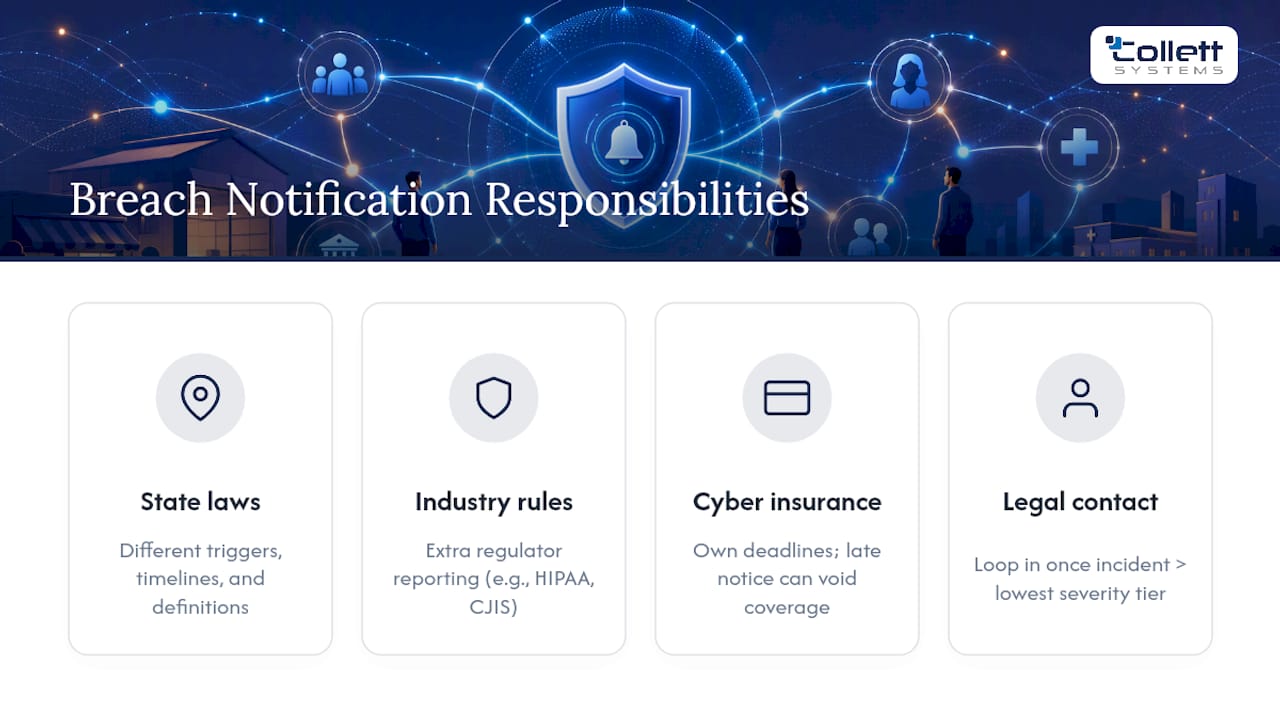
Data breach notification requirements vary by state, industry, and the type of data involved, and getting this wrong carries real financial and legal exposure. Your incident response plan needs a legal contact who can determine, quickly, which notification laws apply to a given incident.
Most states have their own breach notification statutes with different triggers, different timelines, and different definitions of what counts as "personal information." Some require notification within a fixed number of days of discovery; others require notification "without unreasonable delay." If you operate across state lines or serve customers in multiple states, your legal contact needs to check obligations against every applicable jurisdiction, not just the one where you're headquartered.
Industry-specific rules add another layer. Financial firms typically face additional reporting obligations to regulators beyond consumer notification. Healthcare organizations handling protected health information face separate federal breach notification timelines. Government contractors or agencies may face CJIS or other compliance-specific reporting requirements on top of general state law.
Cyber insurance policies frequently include their own notification requirements, often with tighter deadlines than statutory law, and failing to notify your insurer within the policy's window can jeopardize coverage entirely. Your plan should list your insurer's claims contact and notification deadline right alongside your regulatory contacts.
None of this is something your Technical Lead should be figuring out mid-incident. The plan's legal contact, whether in-house counsel or an outside firm, needs to be looped in the moment an incident is classified above your lowest severity tier, so notification clocks don't start running before anyone's aware they exist.
Does Everyone in the Company Need Incident Response Training?
An incident response plan only functions if the people most likely to spot the first signs of trouble, which is almost never IT, know what to do in the first five minutes. Training can't be limited to the response team.
Every employee needs baseline awareness training covering how to recognize phishing, what to do if they suspect their credentials are compromised, and who to contact immediately. This training works best delivered at onboarding and refreshed at least annually, since attack techniques evolve and awareness fades without repetition.
The designated incident response team needs a deeper level of training beyond general awareness: role-specific instruction on the playbooks they're responsible for executing, hands-on familiarity with the actual tools (SIEM, EDR, backup consoles) they'll use during a real event, and participation in the tabletop and simulation exercises covered earlier in this guide.
Managers and executives need a distinct training track focused on their decision authority under the plan: when to escalate, who has authorization for what, and how to communicate calmly with staff and customers during an active incident. Executives who haven't reviewed the plan in the last year are often the biggest bottleneck during a real one, hesitating on decisions the plan already delegates to them.
Track training completion the same way you'd track any compliance requirement, with records showing who completed what and when. If you ever need to demonstrate due diligence to a regulator, an insurer, or a court, a documented training program is often the difference between a defensible response and a negligence claim.
How Do You Classify and Prioritize Incidents?
Not every alert deserves the same response, and treating a low-risk event with the same urgency as active ransomware burns out your team and delays the response that actually matters. Classification criteria need to be specific enough that two different people would independently reach the same severity tier for the same incident.
Classification typically weighs three factors together: the type of system or data affected, the scope of the compromise, and the confirmed or likely impact. A phishing email that got reported before anyone clicked it is a different tier than one where credentials were harvested and used to log into your email system. A single infected workstation is a different tier than lateral movement toward a domain controller.
Build your classification criteria around business impact, not just technical severity. A compromised marketing laptop with no access to sensitive systems might be lower priority than a moderately technical issue on a system processing customer payment data, even if the payment system incident looks less severe from a pure malware standpoint.
Prioritization also needs to account for the confidence level of the detection. A confirmed indicator of compromise from your EDR platform warrants faster action than an anomaly flagged by a behavioral rule that historically produces false positives. Build that context into your severity matrix so responders aren't treating every alert type identically regardless of its track record for accuracy.
Revisit your classification criteria at least annually, and definitely after any incident where the assigned tier turned out to be wrong in hindsight. If a Tier 2 incident escalated to Tier 3 halfway through, that's a signal your initial classification triggers need adjustment, not a one-off exception.
What Other Metrics Show Your Incident Response Program Is Working?
MTTD and MTTC get most of the attention, but they only tell part of the story. A program tracking just those two numbers can look great on paper while still leaving significant gaps in actual resilience.
Containment time measures how long it takes from confirmed detection to full containment, distinct from the initial response time MTTC often captures. This matters because an incident can be "contained" in the sense that spread has stopped, while remnants of the threat remain active elsewhere in the environment.
Recovery time tracks how long it takes to return affected systems to normal operation after containment, which is often the longest phase of the entire incident and the one your business stakeholders care about most. A fast detection and containment followed by a two-week recovery is not the win it looks like on a dashboard.
Playbook execution rate tracks what percentage of an incident's response actually followed the documented playbook versus improvised steps. A low execution rate signals either an outdated playbook or a training gap, and it's one of the more honest indicators of whether your plan is truly operational.
Escalation accuracy tracks how often incidents were classified at the correct severity tier on the first attempt. Frequent reclassification mid-incident suggests your classification criteria need revision.
Repeat incident rate tracks whether the same vulnerability or attack vector shows up again after a previous incident's remediation. A recurring root cause is the clearest sign that your post-incident retrospective process is documenting lessons without actually implementing them.
Track these quarterly alongside MTTD and MTTC, and review trends over multiple incidents rather than reacting to any single event in isolation.
The Gap Between a Written Plan and a Working One
Most organizations we talk to already have some version of an incident response plan sitting in a shared drive. Almost none of them have tested it in the last year, and a smaller number still could tell you, without checking, who's authorized to take a server offline at 2 a.m. That gap between having a document and having a capability is the whole game, and it's the part most guidance glosses over in favor of frameworks and templates.
The conventional advice tells you to pick NIST or SANS, fill in a template, and file it. What that advice underweights is that a plan's real value shows up in the specificity of its playbooks and the discipline of its testing cadence, not the elegance of its phase diagram. We've watched organizations with a beautifully structured four-phase plan flounder during a real ransomware event because nobody had actually rehearsed who calls the cyber insurance carrier first. Meanwhile, a leaner plan with tight, tool-specific runbooks and a quarterly tabletop habit performs better every time, because the team has already made the hard decisions once, on paper, before they had to make them for real.
For small and mid-sized organizations specifically, the retainer relationships matter as much as the document itself. A plan that names a DFIR firm you've never spoken to is functionally different from one built alongside a managed security provider who already knows your environment. That familiarity is what turns response time from hours into minutes when it counts.
, Dustin Collett
How Collett Systems LLC Turns Your IR Plan Into an Operational Capability
Writing the plan is the easy half. Running it under pressure, at 2 a.m., on a Saturday, is where most organizations discover their gaps. Collett Systems LLC builds and operates incident response capability for small and mid-sized organizations across Southeastern Wisconsin as part of a fixed-cost managed IT stack, not a bolt-on add-on billed separately when something goes wrong.
That means 24/7 monitoring watching for the alerts your plan is built to trigger on, managed endpoint detection and response that gives your Technical Lead pre-authorized containment actions instead of manual isolation steps, and a managed firewall configuration that closes the gaps most incidents exploit in the first place. Every client relationship starts with a cybersecurity risk assessment that maps directly to your plan's scope and severity matrix, so the document reflects your actual environment instead of a generic template.
If your incident response plan currently lives in a drawer, or doesn't exist yet, request an IT & Security Assessment and we'll show you exactly where the gaps are before an attacker does.
Authoritative Resources for Building Your Plan
The CISA IRP Basics factsheet is the fastest starting point for understanding required plan elements and approval structure. For the full lifecycle framework and detailed plan checklist, NIST SP 800-61 Revision 2 remains the standard reference federal auditors expect. CISA's Federal Government Cybersecurity Incident and Vulnerability Response Playbooks provide procedural playbook examples you can adapt, and its broader planning, response, and recovery resource hub covers exercises and training materials. For an example of an operational runbook structure applied to a specific threat category, Commerce Catalyst's returns fraud prevention playbook shows how one organization documented decision flow for a live operational risk.
Sources
- Incident Response Plan (IRP) Basics | CISA
- NIST Special Publication 800-61 Revision 2, Computer Security Incident Handling Guide
- Incident Response Plan: Frameworks and Steps | CrowdStrike
FAQ
What Are the 7 Steps of an Incident Response Plan?
A common seven-step breakdown extends NIST's four phases into Preparation, Identification, Containment, Eradication, Recovery, Lessons Learned, and Communication, though exact naming varies by framework and organization.
What Are the 5 Incident Response Steps?
Most five-step versions compress NIST's model into Preparation, Detection, Containment, Eradication and Recovery combined, and Post-Incident Review, though some sources separate Eradication and Recovery into distinct steps instead.
What Is an Example of Incident Response?
A typical example: an EDR alert flags ransomware encryption behavior on an endpoint, the Technical Lead isolates the device within minutes using pre-authorized containment steps, the Incident Manager activates the ransomware playbook, and the scribe begins a timestamped log while legal assesses notification obligations.
How Often Should an Incident Response Plan Be Reviewed?
NIST recommends reviewing the plan at least annually, though quarterly reviews alongside tabletop exercises catch gaps faster than an annual-only cadence.
Do Small Businesses Really Need a Formal Incident Response Plan?
Yes. Small and mid-sized organizations are frequent targets precisely because attackers expect no formal plan, and a documented plan with clear roles and tested playbooks, the kind Collett Systems LLC builds into its managed IT services, cuts response time dramatically compared to improvising during an active incident.