An incident response retainer is a pre-negotiated contract that gives your organization guaranteed, rapid access to expert IR capability before a breach happens. Pre-arranged agreements clarify who can be called, how quickly they engage, and what authority they have, so response begins without procurement delays, legal scrambling, or a cold-start conversation with a firm that has never seen your environment. Buy one if your organization cannot tolerate multi-day dwell time, needs insurer-aligned response, or lacks on-demand forensic depth.
Three priorities to confirm before you sign anything:
- Who needs it most: Organizations with regulated data (HIPAA, PCI DSS, GLBA), insurer panel requirements, or no dedicated internal IR team. Hackers actively target small businesses precisely because they lack this capability.
- Primary contractual priority: A measurable SLA with a named responder and documented privilege handling via outside counsel.
- Top buying signal: You cannot name the IR provider on your insurer's approved panel, or you have never onboarded one.
Which model to consider first: A standby/SLA retainer is the right starting point for most mid-size organizations. Prepaid-hour models suit buyers with predictable incident volume; subscription models work when you want proactive services bundled in. Hybrid arrangements combine elements of both and are common in enterprise contracts.
Key Takeaways
An incident response retainer delivers its full value only when the contract includes a measurable SLA, a named responder, documented privilege handling, and a completed onboarding process before any incident occurs.
| Point | Details |
|---|---|
| Buy before the breach | Pre-negotiated access eliminates procurement delays and cold-start errors when every hour counts. |
| Insist on named responders and SLAs | Vague "commercially reasonable" commitments are not enforceable; require specific time windows and written remedies. |
| Align with your insurer and counsel | Confirm panel acceptance, privilege handling, and billing arrangements before onboarding, not during a claim. |
| Complete onboarding within 90 days | Environment mapping, playbook delivery, and a tabletop exercise within 90 days convert a contract into real readiness. |
| Collett Systems LLC for local SMBs | Collett Systems LLC bundles managed IT, 24/7 monitoring, and emergency response for small and mid-size businesses in Southeastern Wisconsin, providing the environmental familiarity a standalone retainer cannot. |
Recommended next step: Request a cybersecurity risk assessment to map your environment and identify the retainer scope that matches your actual risk profile.
Table of Contents
- What is an incident response retainer, and how does it differ from on-demand IR?
- What retainer pricing models are available, and which fits your organization?
- What does a retainer actually include, and what gets excluded?
- What SLAs should you demand, and how do you make them enforceable?
- How do retainers interact with cyber insurance and legal privilege?
- How do you onboard a retained IR provider so the contract is actually useful?
- How do you evaluate and contract an IR retainer provider?
- How much does an incident response retainer cost in the U.S.?
- Who should buy a retainer, and who should build internal capability instead?
- When does a local managed IT partner with retainer-style support make the most sense?
- What experience actually teaches about retainers
- Collett Systems LLC: managed IT with built-in incident response readiness
- Sources
What is an incident response retainer, and how does it differ from on-demand IR?
The term "retainer" is borrowed from legal services, and the analogy holds. You pay to have a firm on call, pre-authorized, and already familiar with your environment, not to buy hours you may never use. Cyber incidents are a matter of when, not if, and retainers exist because the first hours of a breach determine whether containment costs thousands or millions.
Retainer vs. on-demand IR vs. internal CSIRT, the operational differences:
- Speed: A retained firm has already completed onboarding, knows your network topology, and can begin triage within the SLA window. On-demand IR starts with a cold intake call, often adding 12, 48 hours before meaningful work begins.
- Pre-authorization: Retainer contracts define scope, access credentials handling, and decision authority in advance. On-demand engagements require legal review and procurement approval mid-crisis.
- Pricing predictability: Retainers lock in hourly rates before an incident. Emergency on-demand rates are typically higher and negotiated from a position of weakness.
- Named responders: Quality retainers assign specific analysts to your account during onboarding. On-demand engagements assign whoever is available.
- Legal coordination: Retainer contracts can be structured to route work through outside counsel, preserving attorney-client privilege from day one. Ad-hoc engagements rarely have this in place.
An internal CSIRT is the strongest option when your organization has the headcount, tooling budget, and incident volume to justify it. Most small and mid-size organizations do not. The retainer fills that gap without the overhead of a full internal team. The typical parties in a retainer engagement are your internal SOC or IT lead, the retained IR provider, outside counsel or a breach coach, and your cyber insurer when a claim is involved.
What retainer pricing models are available, and which fits your organization?
Four delivery models dominate the U.S. market. Each carries different cost structures, contractual commitments, and operational tradeoffs.
| Model | How it works | Pros | Cons | Best fit |
|---|---|---|---|---|
| Prepaid hours | You purchase a bank of hours upfront; hours are drawn down during an incident | Predictable spend; pre-negotiated rates locked in | Unused hours may expire; under-buying leaves gaps | Small to mid-size orgs with moderate risk and occasional incidents |
| Standby / SLA | Annual fee guarantees response within a defined SLA window; no hours pre-purchased | Guaranteed availability; cleaner budgeting | Higher annual cost; hours billed separately at incident time | Mid-market and regulated industries needing response certainty |
| Subscription | Monthly or annual fee covers monitoring, proactive services, and a response credit | Proactive value between incidents; bundled tooling | Scope can be narrow; response credits may not cover major incidents | Organizations wanting ongoing advisory plus response backstop |
| Hybrid | Combines prepaid hours with a standby SLA guarantee | Flexibility; cost control with availability guarantee | More complex contract negotiation | Enterprise and high-risk environments |
MSP-focused guidance confirms that providers should price the service for availability and risk, not just hours, which means strict 24/7 SLAs carry an availability premium that reflects real staffing and on-call costs. When you see a retainer priced identically to a block of consulting hours, that is a signal the provider has not built in true availability capacity.
Quick guidance by organization size:
- Small business (under 100 users): Start with a prepaid-hour model bundled with a managed IT provider who already knows your environment. The onboarding cost is lower because the provider already has context.
- Mid-market (100, 1,000 users): A standby/SLA retainer with a named responder and documented escalation path. Insurer panel alignment is non-negotiable at this size.
- Enterprise (1,000+ users): Hybrid model with concurrent incident handling provisions, on-site response triggers, and pre-approved subcontractor lists.
What does a retainer actually include, and what gets excluded?
Understanding scope before you sign is where most buyers lose leverage. Providers vary significantly in what they bundle versus bill separately.
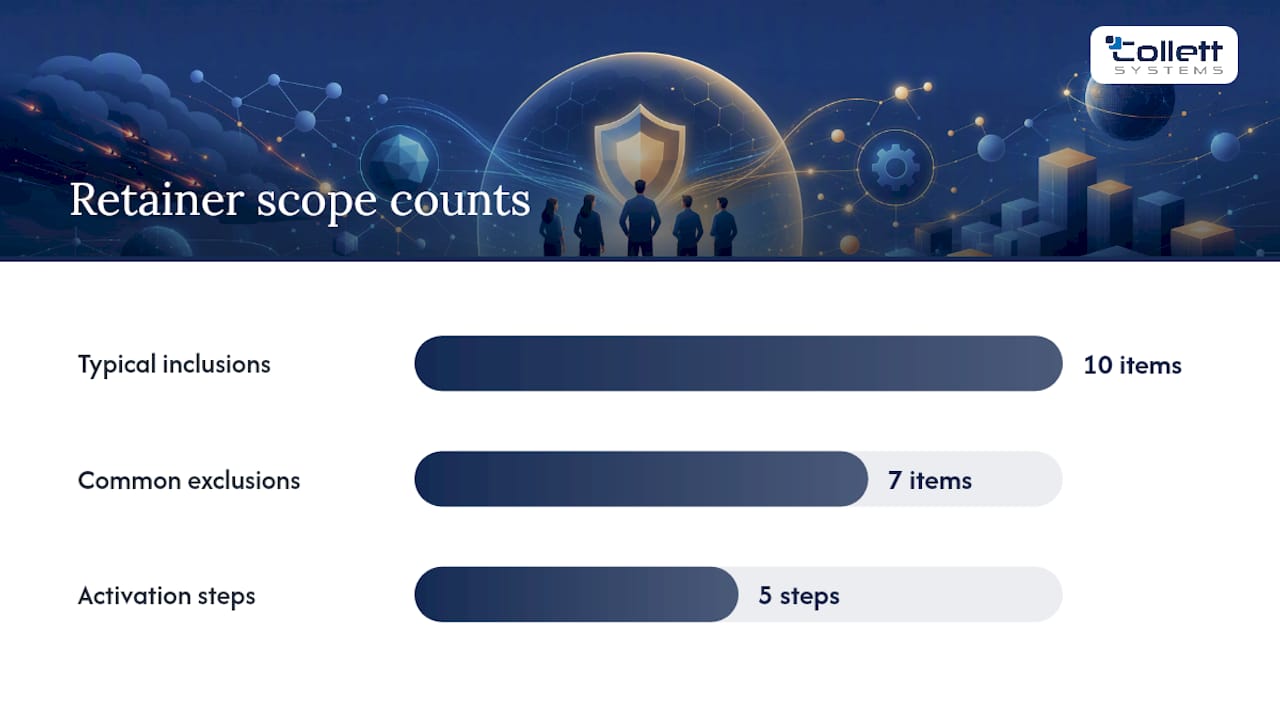
Typical inclusions you should expect:
- 24/7 hotline with documented acknowledgement time
- Initial triage and severity classification
- Remote digital forensics and evidence preservation
- Containment guidance and malware analysis
- Remediation planning and recovery support
- Post-incident report with root cause and lessons learned
- Tabletop exercise (usually one per year)
- Onboarding intake session and environment mapping
- Playbook development or review
- Breach coach coordination and outside counsel introduction
Common exclusions that catch buyers off guard:
- Hardware replacement or physical media acquisition
- Ransom negotiation or cryptocurrency facilitation
- Public relations and crisis communications
- Extended infrastructure rebuilds beyond initial containment
- Third-party tool licensing (EDR, forensic platforms)
- Travel and on-site costs beyond a defined radius
- Incidents caused by pre-existing conditions discovered during onboarding
High-quality retainers include documented evidence preservation procedures, forensic capability, and post-incident reviews that feed risk registers and compliance evidence. If a provider's scope document does not address evidence handling explicitly, that is a gap to close before signing.
The activation flow, step by step:
- Activation: Client contacts the 24/7 hotline; incident is declared per the contract's definition.
- Acknowledgement and triage: Provider confirms receipt within the SLA window and classifies severity.
- Evidence preservation and containment: Forensic imaging begins; containment actions are coordinated with your internal team.
- Forensic analysis and remediation: Root cause investigation, malware analysis, and remediation planning run in parallel.
- Recovery and lessons learned: Systems return to production; post-incident report delivered within the agreed timeframe.
The Microsoft Incident Response Retainer datasheet illustrates how pre-paid hours and activation triggers must be defined clearly in contract language, specifically, whether the clock starts at declaration, at first analyst contact, or at the first billable action. That distinction matters in a ransomware event where every hour counts.
Pro Tip: Ask every provider to define "incident declared" in writing. Vague language here is the single most common source of billing disputes and delayed response.
What SLAs should you demand, and how do you make them enforceable?
An SLA that says "we will respond promptly" is not an SLA. Enforceable commitments require specific time windows, defined triggers, and contractual remedies when the provider misses them.
SLA terms to negotiate:
- Acknowledgement time: The window from incident declaration to confirmed provider receipt. Reasonable targets are 15, 30 minutes for critical severity, 1, 2 hours for high severity, around the clock.
- Time to active engagement: When a named analyst begins substantive work, not just a ticket acknowledgement. This should be 1, 4 hours for critical incidents.
- Named responder availability: Confirm that a specific analyst or team lead is assigned to your account and reachable during onboarding, not just at incident time.
- Escalation tiers: Define who escalates to whom, at what severity threshold, and within what timeframe. Include executive notification paths.
- Penalties and service credits: Missed SLAs should trigger measurable remedies, additional prepaid hours, fee credits, or contract review rights.
Negotiation checklist:
- Define "incident declared" precisely (who can declare, what evidence threshold, written or verbal)
- Separate business-hours SLAs from 24/7 SLAs and price them accordingly
- Specify on-site response triggers (geography, incident type, severity threshold)
- Require SLA testability, the provider must participate in at least one tabletop per year that tests the acknowledgement and escalation chain
- Document escalation contacts by name and role, not just by job title
Gartner's market review of DFIR retainer services consistently identifies named responders, measurable SLAs, and onboarding as the features buyers most often wish they had insisted on before an incident. Buyers who skipped those requirements during procurement almost universally regret it.
How do retainers interact with cyber insurance and legal privilege?
Your cyber insurer and your IR retainer are not independent decisions. Getting the coordination wrong can delay your claim, compromise privilege, or leave you paying out-of-pocket for a provider your insurer will not reimburse.
Questions to ask your broker before signing a retainer:
- Does our policy require IR providers from an approved panel?
- Will the insurer reimburse a provider we select independently?
- Are pre-negotiated retainer rates recognized, or does the insurer apply its own rate schedule?
- What documentation does the insurer require at incident declaration?
- Does the policy cover proactive retainer costs (tabletops, playbook development)?
Contract language topics to address with outside counsel:
- Direction of IR work through outside counsel to establish privilege from the first engagement
- Evidence handling procedures and chain-of-custody documentation
- Data access limits (what systems the provider can access, under what authorization)
- Confidentiality obligations covering forensic findings and incident details
- A privilege agreement executed before onboarding, not after an incident
Insurers frequently maintain panels of approved IR providers, which makes it critical to pre-onboard any insurer-recommended firm and verify its SLAs and forensic capabilities before an incident. The risk of relying solely on an insurer's panel without independent vetting is real: panel providers may have response-time commitments that vary by client tier, and your organization may not be their priority.
Understanding why cyber insurance claims get denied is equally important. Insurers have denied claims where the organization used a non-panel provider without prior authorization, or where forensic evidence was handled in ways that undermined the claim.
The practical fix: Pre-onboard your chosen provider with your insurer's knowledge. Get written confirmation that the provider is acceptable for reimbursement. Then complete the full onboarding process so the provider is operationally ready, not just contractually engaged.
How do you onboard a retained IR provider so the contract is actually useful?
Signing a retainer and onboarding a retainer are two different things. A contract sitting in a drawer does not reduce dwell time. Onboarding and environmental familiarity materially speed containment and reduce errors, that is the operational value buyers pay for.
Onboarding checklist:
- Environment mapping: Document network topology, critical asset inventory, and data classification.
- Credentials handling plan: Define how the provider accesses systems during an incident (break-glass accounts, MFA bypass procedures, VPN access).
- Logging and EDR integration: Confirm the provider can ingest your SIEM logs and EDR telemetry without delay.
- Critical asset identification: Agree on which systems trigger immediate escalation versus standard response.
- Communications list and decision authority: Name who can declare an incident, who approves containment actions, and who communicates externally.
- Tabletop schedule: Book the first exercise within 30 days of contract execution.
Sample 30/60/90-day onboarding timeline:
- Days 1, 30: Intake session, environment documentation, credentials handling agreement, outside counsel introduction, privilege agreement executed.
- Days 31, 60: Playbook delivery and review, logging integration confirmed, EDR access tested, escalation contacts validated.
- Days 61, 90: First tabletop exercise conducted, gaps identified, playbook updated, insurer notified of provider onboarding.
Outside counsel should be looped in at day one, not after an incident. The privilege agreement needs to be in place before the provider touches any forensic data. Your insurer contact should receive written notice that onboarding is complete, this creates a documented record that supports claim processing later.
How do you evaluate and contract an IR retainer provider?
Use this checklist during vendor selection and contract negotiation. The questions are designed to surface capability gaps and contractual risks before you commit.
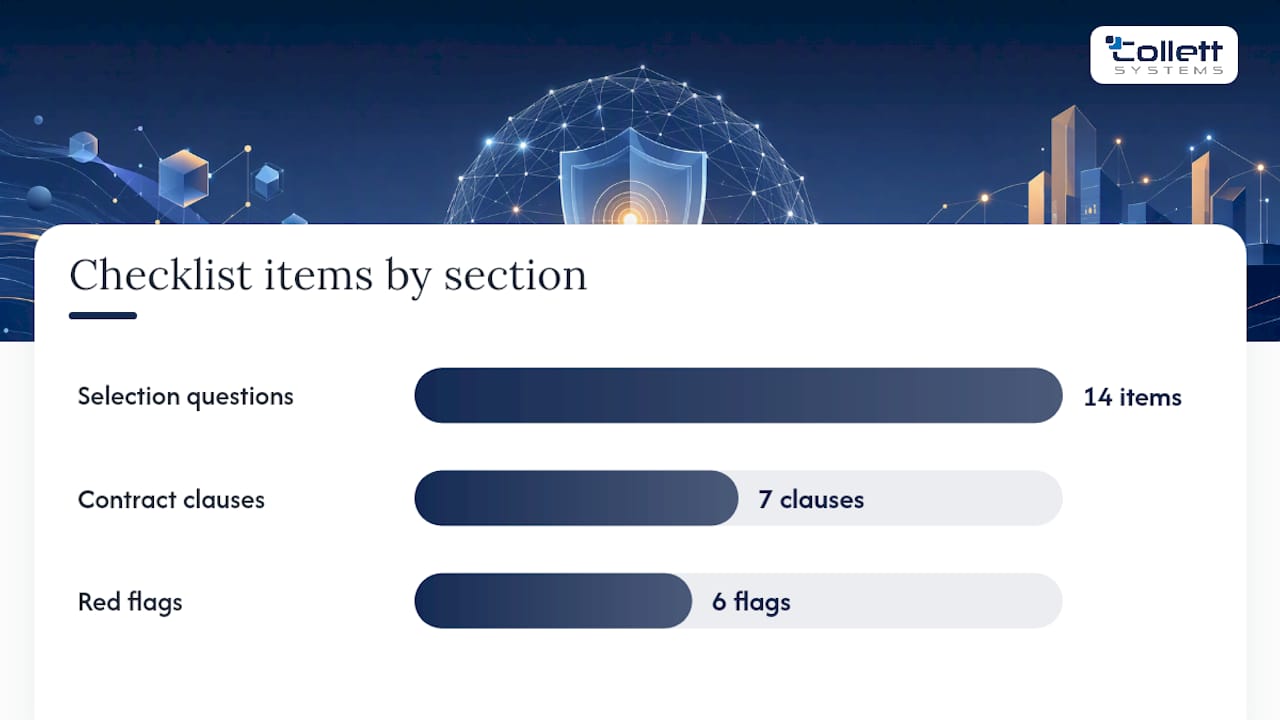
Questions to ask every provider (minimum 12):
- What is your guaranteed acknowledgement time for a critical-severity incident, in writing?
- Who is the named responder assigned to our account, and what is their direct contact?
- How many concurrent incidents can your team handle without degrading our SLA?
- What is your staffing depth for 2 AM on a holiday weekend?
- How do you handle evidence preservation, and what chain-of-custody documentation do you provide?
- What systems and data do you require access to during onboarding, and how is that access secured?
- Do you work with outside counsel to preserve attorney-client privilege?
- Are you on any major cyber insurer panels, and which ones?
- What is your on-site response capability, and what triggers it?
- How are unused prepaid hours handled at contract renewal?
- What subcontractors do you use, and are they pre-approved in the contract?
- What does your post-incident report include, and when is it delivered?
- How do you handle incidents that exceed the contracted scope or hours?
- Can we speak with two current clients who have activated the retainer?
Contract clauses to insist on:
- Covered systems defined explicitly (not "client environment" as a catch-all)
- SLA metrics with specific time windows and written remedies for misses
- Carryover policy for unused hours (minimum 12-month carryover or rollover credit)
- Pre-approved subcontractor list with no substitution without client consent
- Privilege handling routed through outside counsel, documented in the contract
- Termination triggers and notice periods (you need an exit if the provider is acquired or degrades)
- Indemnity and limits of liability stated clearly, not buried in general terms
Red flags that should stop a negotiation:
- Acknowledgement SLA defined as "commercially reasonable efforts" with no time window
- No named responder; only a team or queue assignment
- Insurer panel membership cited as the only qualification, with no independent onboarding provisions
- Exclusivity clauses that prevent you from engaging other specialists during an incident
- Overage rates not disclosed until after contract execution
- No tabletop exercise included or offered
How much does an incident response retainer cost in the U.S.?
Pricing varies significantly based on SLA strictness, included hours, staffing depth, on-site commitments, industry and regulatory requirements, forensic tooling, geographic coverage, and insurer alignment. MSP guidance confirms that providers should price for availability and on-call costs, not just hours delivered, which is why two retainers with the same hour count can differ substantially in annual cost.
Illustrative U.S. market ranges:
These ranges are illustrative. Actual pricing depends on the provider's cost structure, your geographic location, and the specific SLA commitments negotiated. Retainers reduce dwell time and overall incident cost by enabling faster containment and pre-negotiated rates compared to emergency on-demand engagements, where rates are higher and response is slower.
Pro Tip: Align your retainer spend with your cyber insurance limit. If your policy covers $1M in incident costs, a retainer that reduces average dwell time by even 24 hours can prevent losses that dwarf its annual cost. Run a simple scenario: what does a 72-hour ransomware event cost your organization in downtime, recovery labor, and regulatory exposure? That number is your retainer budget floor.
Unused prepaid hours can often be redirected to proactive services such as tabletop exercises, threat hunting, or vulnerability assessments, which means a well-structured retainer delivers value even in years when no major incident occurs.
Who should buy a retainer, and who should build internal capability instead?
The honest answer is that most organizations below 500 employees should buy, not build. Building a credible internal IR capability requires dedicated headcount, forensic tooling, 24/7 on-call rotations, and continuous training, a cost that exceeds most retainer contracts by a wide margin.
Buy a retainer when:
- Your organization holds regulated data (PHI, PCI, financial records) and faces mandatory breach notification timelines
- Your cyber insurer requires or strongly recommends a pre-approved IR provider
- You have no dedicated IR analyst or forensic capability in-house
- Your recovery time objective (RTO) is under 24 hours and you cannot meet it without external help
- You have experienced an incident in the past 24 months and lacked a structured response
Build internal capability when:
- You have sufficient incident volume to justify dedicated headcount (typically 10+ significant incidents per year)
- You operate in a classified or air-gapped environment where external providers cannot be granted access
- Regulatory requirements mandate internal control over forensic data
Hybrid approach, what to keep in-house vs. retain externally:
- Retain externally: Digital forensics, ransomware containment, breach coaching, malware reverse engineering, legal coordination
- Keep in-house: SIEM monitoring, routine patching, user access management, first-line triage, internal communications
Industry triggers that often force the retainer decision include payment card processor requirements (PCI DSS), healthcare breach notification rules under HIPAA, financial services obligations under GLBA, and litigation exposure where forensic chain-of-custody is critical. Small businesses are disproportionately targeted and are least likely to have internal IR depth, which makes the retainer decision straightforward for most.
When does a local managed IT partner with retainer-style support make the most sense?
For small and mid-size U.S. businesses, the most practical IR model is often not a standalone retainer with a national firm. It is a local managed IT provider who already knows your environment, manages your backups, and can respond hands-on when containment requires physical access.
How a local managed IT plus retainer model helps:
- The provider already has your network documentation, credentials, and asset inventory from day-to-day management, onboarding is largely complete before an incident occurs
- Backup and disaster recovery are managed by the same team, so recovery decisions are faster and better coordinated
- Regulatory and compliance documentation (required for HIPAA, PCI, or state breach notification) is maintained as part of ongoing managed services, not assembled under pressure during a breach
- Local presence means on-site response without travel costs or geographic SLA exceptions
Organizational signals that point toward a local managed partner:
- You need hands-on recovery support, not just remote forensic guidance
- Your compliance obligations require documented, ongoing security management
- Executive leadership expects regular reporting on security posture, not just incident-by-incident updates
- Your internal IT team is one or two people who cannot manage a breach response alone
Collett Systems LLC serves over 150 organizations across Southeastern Wisconsin with a fully managed IT stack that includes 24/7 monitoring, proactive security management, backup and disaster recovery, and emergency IT support. For small and mid-size businesses in this region, that model provides the environmental familiarity and local accountability that standalone retainer contracts from national firms cannot replicate. This is one valid model among several, procurement teams should still validate SLAs, contract language, and provider capabilities regardless of which path they choose.
What experience actually teaches about retainers
The most common mistake organizations make is treating a signed retainer as a solved problem. The contract is the starting line, not the finish line. Every retainer that has actually performed well in a crisis had one thing in common: the provider had already been inside the environment, tested the escalation chain, and sat across the table from the legal team before any incident occurred. The tabletop exercise is not a nice-to-have, it is the only way to find out whether your SLA language actually works in practice, whether your named responder knows your environment, and whether your outside counsel and IR provider have a working relationship. Run it within 30 days of onboarding. If the provider resists scheduling it, that tells you something important about how they will perform at 2 AM on a Sunday.
Collett Systems LLC: managed IT with built-in incident response readiness
For small and mid-size businesses in Southeastern Wisconsin, the fastest path to retainer-level readiness is a managed IT partner who already knows your infrastructure. Collett Systems LLC delivers a fully loaded IT stack with fixed per-user pricing, 24/7 monitoring, proactive security management, backup and disaster recovery, and emergency IT support, so when an incident occurs, the response team already has your environment documented, your backups tested, and your escalation contacts on file.
That operational familiarity is what standalone retainer contracts from national firms cannot replicate for a 40-person manufacturer or a regional financial services firm. Our team serves over 150 organizations across the region with documented security management, compliance support, and real client references. To find out whether our managed IT services fit your risk profile and retainer needs, start with a paid IT and Security Assessment, a structured review of your environment, security posture, and response readiness that gives you a clear picture before you commit to any contract. Procurement teams should still validate SLAs and contract language with their legal counsel; we welcome that scrutiny. Book your assessment to get started.