A data classification policy is a formal scheme that assigns persistent sensitivity labels to data so your organization applies the right controls at the right time. Start with a data inventory and a practical tier model of a few levels. Templates, a handling matrix, and a rollout plan follow below so you can move from concept to working policy this quarter.
TL;DR:
- Most small and midsize organizations should limit classification tiers to four to ensure consistent labeling and avoid employee fatigue.
- Automated discovery tools and confidence-based auto-labeling significantly reduce manual effort, but require proper calibration and human review for uncertain cases.
- Regular governance, audits, KPIs, and version control are essential to keep the classification program active and compliant through ongoing updates.
- Proper mapping of data types and regulated data categories into the correct tiers prevents gaps that auditors can flag and reduces over-classification.
- Outsourcing enforcement, monitoring, and tuning to a managed provider can ensure ongoing compliance without overburdening internal IT teams.
Table of Contents
- What Every Data Classification Policy Must Include
- Choosing Classification Levels That Actually Get Used
- Building a One-Page Handling Matrix for Every Tier
- Rolling Out the Policy Without Stalling in Committee
- Picking Tools That Automate Labeling Without Creating Noise
- Keeping the Policy Alive: Governance, Audits, and KPIs
- The Mistakes That Quietly Kill Adoption
- Templates You Can Copy Into Your Own Policy
- Why This Guidance Comes From Practical IT Operations Experience
- Should You Build This In-House or Bring in a Managed Provider?
- Turn This Policy Into a Managed, Enforced Program
- Standards Worth Bookmarking
- Sources
- FAQ
What Every Data Classification Policy Must Include
A data classification policy earns its place in an audit binder only if it answers three questions plainly: what data it covers, who owns each decision, and what happens when someone breaks the rules. Skip any of those and you have a memo, not a policy.
Purpose and scope come first. State the policy's goal in one sentence: to assign consistent sensitivity labels to organizational data so protection controls match risk. Scope should name the systems (file servers, cloud storage, email, databases, backups), data types (customer records, financial data, intellectual property, employee files), and third parties covered, including vendors and contractors who touch your data. NIST IR 8496 frames classification as the process of characterizing data assets with persistent labels that trigger appropriate protections, and that definition belongs near the top of your document because it anchors everything that follows.
Roles and responsibilities need names attached to functions, not just titles floating in the abstract:
- Policy owner (often the CISO, IT director, or compliance lead) maintains the document and approves changes.
- Data owners (department heads or business unit leaders) decide the correct classification for data their team creates.
- Data stewards apply labels day to day and flag misclassified files.
- IT/security builds and maintains the technical controls: encryption, access restrictions, monitoring.
- Legal/compliance reviews regulatory mapping and signs off on exceptions.
Authority and enforcement language is where most draft policies go soft, and that's a mistake. Spell out the approval chain (who signs off on the policy and on revisions), version control (a simple changelog with date and approver), the exception process (who can grant a temporary deviation and for how long), and consequences for violations, tied to your existing disciplinary policy rather than invented on the spot. NIST guidance notes that a classification scheme should stay distinct from the protection requirements it triggers, so keep the label definitions in one section and the specific controls in another. That separation makes the policy easier to update when a new regulation or tool arrives, since you're not rewriting definitions every time a control changes.
Choosing Classification Levels That Actually Get Used
Around four tiers is often recommended for most small and midsize organizations. More than that, and employees stop labeling things correctly out of fatigue; fewer, and you lose the granularity that regulated data needs.
A workable model, consistent with the SMB-focused framework many small organizations adopt, looks like this:
| Tier | Definition | Example Data |
|---|---|---|
| Public | Approved for release outside the organization with no restriction | Marketing brochures, published press releases, job postings |
| Internal | Routine business data not meant for public release but low risk if exposed | Internal memos, meeting notes, org charts |
| Confidential | Sensitive business data that would cause real harm if disclosed | Contracts, financial forecasts, unreleased product plans |
| Restricted | Regulated or high-impact data requiring the strictest controls | Protected health information (PHI), payment card data (PCI), Social Security numbers and other PII |
Restricted is typically reserved for PHI, PCI, and PII, which usually require the strictest controls due to legal exposure. FIPS 199 offers a useful lens here: rate the confidentiality, integrity, and availability impact of a breach for each data type, and let the highest impact rating drive the tier assignment, not the department that happens to generate the data.
Map your existing file shares and databases against this table before you write another word of policy. If a folder holds a mix of contracts and marketing flyers, that's a sign the folder needs to be split, not that you need a fifth tier.

Building a One-Page Handling Matrix for Every Tier
Classification tiers mean nothing without handling rules attached to them. A handling matrix translates "Confidential" or "Restricted" into concrete instructions for storage, sharing, transmission, retention, and access, all on a single page your team can reference without hunting through a 40-page policy document.
| Control area | Internal | Confidential | Restricted |
|---|---|---|---|
| Storage | Standard shared drives, no special vault | Access-controlled folders or approved cloud storage | Encrypted vaults with restricted membership lists |
| Sharing | Internal recipients only, no restriction on forwarding | No external sharing without owner approval | No external sharing; anonymous links disabled entirely |
| Transmission | Standard email acceptable | Encrypted email or secure file transfer required | Encrypted transfer only, logged and monitored |
| Access controls | Standard login | Multifactor authentication (MFA) required | MFA plus conditional access and privileged role review |
| Retention | Per department schedule | Defined retention period tied to business need | Retention set by regulatory requirement, typically several years |
| Disposal | Standard deletion | Secure deletion with audit trail | Cryptographic erasure or physical destruction, documented |
A few of these rules deserve emphasis beyond the table. Anonymous sharing links, the kind that let anyone with the URL open a file, have no place touching Confidential or Restricted data; disable them at the platform level rather than trusting individual judgment. Retention periods for Restricted data should be set by whatever regulation applies, HIPAA, PCI DSS, or state breach notification law, not by a generic "keep everything forever" habit. And disposal needs an audit trail: a log entry showing what was deleted, when, and by whom, matters as much during an audit as the deletion itself.
For network-level enforcement of these tiers, especially around Restricted data storage, segmenting your network so sensitive systems sit apart from general traffic makes the handling matrix enforceable rather than aspirational.
Rolling Out the Policy Without Stalling in Committee
A classification policy that lives only in a document nobody reads accomplishes nothing. The rollout matters as much as the writing.
- Run a discovery inventory first. Identify where your highest-risk data lives, financial systems, HR files, customer databases, before touching anything else. Prioritize by risk, not by alphabetical folder name.
- Choose a labeling method and pilot it small. Options range from simple filename conventions and folder structure to metadata-based sensitivity labels like those in Microsoft Purview. Pick one team or department for a two to four week pilot before rolling out company-wide.
- Build a training plan with a real communications cadence. A single kickoff email will not change behavior. Plan a launch announcement, a short mandatory session, and a 30-day follow-up reminder.
- Get legal review on the exception process before launch, not after the first employee asks for one. Regulated data categories need sign-off from whoever owns your compliance obligations.
- Track KPIs from week one: label coverage rate, override frequency (how often people manually change an auto-assigned label), and time-to-classify per document. ITU Online's implementation guidance recommends measuring these before expanding a pilot to the full organization, and that discipline catches a broken workflow before it scales into a company-wide headache.
Pro Tip: If a manual classification step takes longer than about five seconds per document, adoption will drop off fast. Default to automatic label suggestions or folder-based inheritance rather than asking employees to make a judgment call on every file they save.
Picking Tools That Automate Labeling Without Creating Noise
Two categories of tooling handle most of the work here: discovery engines that scan content for sensitive patterns, and metadata-only systems that rely on manual or rule-based tagging. Discovery tools cost more to configure but catch what manual tagging misses, particularly in old file shares nobody has touched in years.
- Discovery and classification engines scan file contents and context (not just filenames) to flag Social Security numbers, credit card patterns, or health record formats automatically.
- Auto-labeling with confidence thresholds applies a tier automatically when the tool is highly confident, and routes uncertain matches to a human review queue instead of guessing.
- Data loss prevention (DLP) integration ties the label to an enforcement action, blocking an email with a Restricted attachment from leaving the organization, for instance, rather than just tagging it after the fact.
- Sensitivity label platforms, like the framework described in Microsoft's data classification implementation guidance, work best with a one-to-one mapping between your policy tiers and the platform's label names, so Confidential in your policy is literally "Confidential" in the tool, not a differently named equivalent.
The NCCoE's unstructured data classification project demonstrated that discovery tools can be validated against synthetic test datasets before ever touching production files, which lets you tune false-positive rates without risking real customer data during setup. That single step avoids the common failure mode of an over-eager DLP rule quarantining half the finance department's email on launch day. The most durable programs pair automation with human review rather than trusting either alone: set the confidence threshold high enough that only clear matches get auto-labeled, and route the rest to a steward for a quick manual call. AI-assisted document discovery can speed up the initial scan of legacy file shares considerably before you configure ongoing DLP rules.
Keeping the Policy Alive: Governance, Audits, and KPIs
A classification policy that never gets revisited becomes shelfware within a year. Governance is what keeps it current.
- Charter a governance body, even a lightweight one. A quarterly review committee of the policy owner, one data owner, and someone from IT security is enough for most small organizations.
- Collect audit evidence on a set schedule: label coverage reports, DLP incident logs, and access review records, reviewed at least quarterly and ideally tied to your existing change management process.
- Track KPIs that mean something: label coverage percentage across your top five data repositories, override rate (how often auto-labels get manually corrected), and training completion rate.
- Version every revision with a date, an approver, and a one-line summary of what changed, so an auditor can trace the policy's history in minutes rather than hours.
- Route exceptions through a documented approval chain, never an informal email thread that disappears from the record.
The Mistakes That Quietly Kill Adoption
Most failed classification programs don't fail loudly. They fail through slow erosion, one ignored label at a time.
- Over-classification is the most common trap: mark everything Confidential "to be safe," and the label loses all meaning while everyone develops security fatigue. Reserve Restricted for data that genuinely carries regulatory weight.
- No enforcement or measurement turns the policy into a document nobody checks. Add spot audits and real KPIs from day one, not as an afterthought six months in.
- Ignoring regulated data during the mapping phase creates gaps auditors find immediately. Map HIPAA, PCI DSS, and state privacy law obligations to your tiers before launch, not after a breach notification deadline forces the question.
- Treating automation as infallible invites both missed sensitive files and infuriating false positives. A hybrid approach, automated suggestions with human review for anything below a high confidence threshold, holds up better over time than either full automation or full manual review.
Templates You Can Copy Into Your Own Policy
Sample policy language saves hours of drafting. Adapt the wording below to your organization's name and specific systems.
Purpose: "This policy establishes a framework for classifying organizational data based on sensitivity and regulatory requirements, to ensure consistent protection across all systems and third parties handling company data."
Scope: "This policy applies to all data created, stored, or transmitted by [Organization], including data held by third-party vendors and cloud service providers, across all business units."
The handling matrix from earlier in this guide is built to be pasted directly into a policy appendix, with your organization's specific tool names substituted for the generic categories.
A two-week pilot checklist:
- Week 1: Complete inventory of the pilot department's data stores; assign tier definitions to sample files.
- Week 1: Configure discovery tool with test dataset before touching live files.
- Week 2: Launch pilot labeling with a designated data steward reviewing all auto-label suggestions.
- Week 2: Collect coverage and override rate metrics; hold a short retrospective before expanding scope.
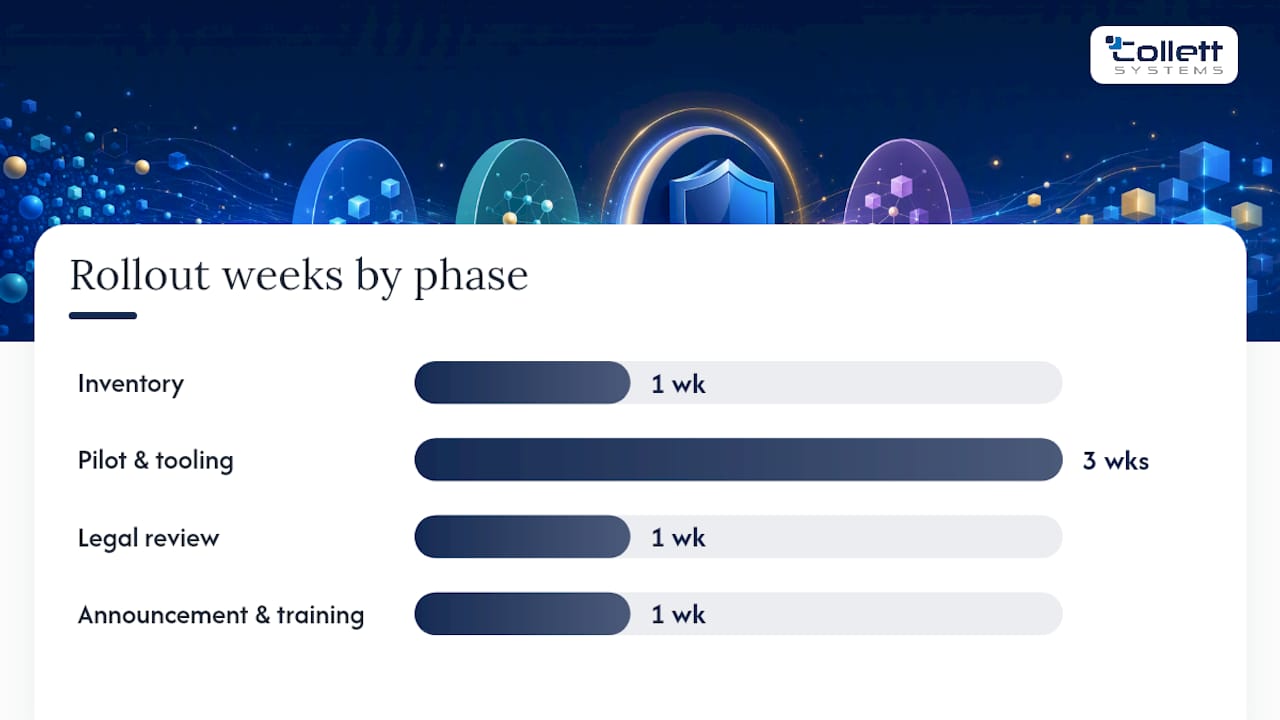
This mirrors the broader six to eight week SMB rollout timeline: inventory in week one, pilot and tooling configuration through week four, legal review in week five, and companywide announcement and training by week six.
Why This Guidance Comes From Practical IT Operations Experience
Collett Systems LLC builds and operates managed IT environments for small and midsize businesses across Southeastern Wisconsin, including cybersecurity services that put classification handling rules into daily practice rather than leaving them on paper. Relevant capabilities behind this guide include:
- Ongoing 24/7 monitoring across client environments, which surfaces where classification breaks down in real use
- Direct experience configuring DLP rules, access controls, and encryption to match tiered handling requirements
- Backup, disaster recovery, and compliance documentation work that depends on accurate data classification to function correctly
- AI risk assessment work that extends classification principles into newer data types and automated systems
Should You Build This In-House or Bring in a Managed Provider?
Hiring outside help makes sense when your team lacks bandwidth for continuous monitoring, when regulated data (PHI, PCI, PII) raises the compliance stakes, or when DLP tuning requires more hands-on attention than your internal staff can spare. In-house teams can absolutely handle the inventory, tier definitions, and initial policy draft themselves; those don't require specialized tooling. What usually strains a small IT team is sustaining enforcement and tuning false positives over months, not writing the first draft. Collett Systems LLC typically engages in three phases: an assessment to map existing data and gaps, a pilot to test labeling and DLP rules on a limited scope, and ongoing tuning once the program is live.
, Dustin Collett
Turn This Policy Into a Managed, Enforced Program
Writing the policy is the easy half. Enforcing it every day, tuning DLP rules, reviewing override rates, keeping labels current as your systems change, is where most internal teams run out of hours. Collett Systems LLC is the alternative to hiring a dedicated compliance analyst: one fixed monthly price per user covers the full stack, including the monitoring and DLP tuning a classification policy needs to actually work, with no separate line item for "security add-ons" later.
Our engagement model starts with an assessment of your current data environment, moves into a pilot on your highest-risk systems, and settles into ongoing managed operations, 24/7 monitoring, proactive alerting, and quarterly reviews of label coverage and override rates included. For manufacturers and financial firms carrying regulated data, this structure closes the gap between a written policy and one that survives a real audit. If you're ready to see where your data actually stands, book the IT & Security Assessment and get a concrete starting point instead of a guess.
Standards Worth Bookmarking
A handful of primary sources will serve you better than most blog posts when you need to defend a decision to an auditor or executive team:
- NIST IR 8496 defines classification functions and ties labeling to governance, discovery, and monitoring, the closest thing to a canonical federal reference on this topic.
- The NCCoE's SP 1800-39 project demonstrates real-world discovery and labeling of unstructured data with commercially available tools.
- FIPS 199 gives the impact-rating methodology for mapping confidentiality, integrity, and availability risk to a tier.
- Microsoft's implementation guidance covers mapping policy tiers directly to sensitivity labels in a Microsoft 365 environment.
Sources
- NIST IR 8496: Data Classification Practices and Considerations
- NCCoE SP 1800-39: Data classification practices for unstructured data
- Microsoft Learn: Create a data classification framework
- FIPS 199: Standards for Security Categorization of Federal Information and Information Systems
FAQ
What are the four types of data classification?
Most organizations use Public, Internal, Confidential, and Restricted, with Restricted reserved for regulated categories like PHI, PCI data, and personally identifiable information.
What are the five data classifications some frameworks use?
Some larger enterprises and government frameworks add a fifth tier, often "Top Secret" or "Highly Restricted," between Confidential and Restricted, but most small and midsize organizations get better adoption results sticking to four tiers or fewer.
What are the NIST data classification standards?
NIST doesn't mandate a single fixed scheme; instead, NIST IR 8496 defines the functions classification should serve (labeling, discovery, monitoring, governance) while FIPS 199 provides the impact-based methodology many organizations use to set their own tiers.
What is a GDPR data classification policy?
GDPR itself doesn't require a specific classification scheme, but organizations subject to it typically map personal and sensitive personal data categories into their Restricted or Confidential tier to apply the stricter handling and retention rules GDPR requires.
How do I know if I need a managed provider instead of doing this myself?
If your organization handles regulated data (PHI, PCI, PII) or lacks staff for continuous DLP tuning and monitoring, a managed provider like Collett Systems LLC typically closes that gap faster than building the capability from scratch in-house.