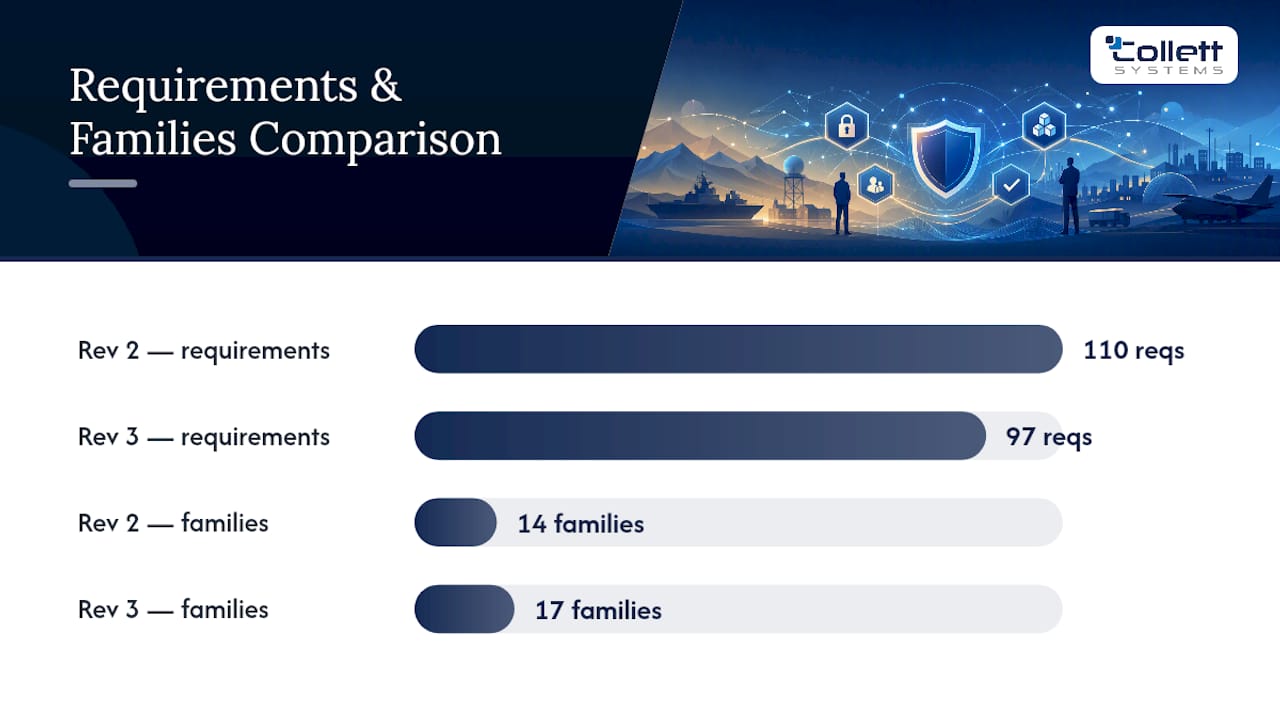
NIST 800-171 controls are the security requirements nonfederal organizations must implement to protect Controlled Unclassified Information (CUI), and the single most urgent move for any handler of CUI is starting a System Security Plan (SSP) and gap assessment now. Revision 2 includes 110 requirements organized into 14 families; Revision 3 contains 97 requirements grouped into 17 families. Your contract language, not your preference, decides which one governs.
TL;DR:
- Scoping CUI systems to include only essential components simplifies compliance efforts and reduces remediation costs, especially for small businesses.
- Implementing multi-factor authentication, FIPS-validated encryption, and detailed logging with review procedures are the controls most likely to delay assessment progress if neglected.
- Accurate documentation in the system security plan, including specific control owners and configuration details, is critical for passing assessments and avoiding failures.
- The contract determines whether Revision 2 or Revision 3 controls apply, influencing your compliance scope, assessment criteria, and reporting requirements.
- Achieving compliance requires a prioritized approach starting with gap assessments, boundary definition, and remediating high-impact controls before addressing remaining gaps.
Table of Contents
- What Are the NIST 800-171 Controls, Family by Family?
- Who Must Comply With NIST 800-171?
- How Do You Scope a CUI System Without Overwhelming Your Team?
- Which Controls Demand the Most Work to Implement?
- How Are NIST 800-171 Controls Actually Assessed?
- What's the Fastest Path to Compliance for a Small Contractor?
- Why Most Compliance Failures Aren't Technical
- Get Help Turning Controls Into a Working Compliance Program
- Sources
- FAQ
What Are the NIST 800-171 Controls, Family by Family?
The controls group into families that each cover one slice of your security program: access control, audit and accountability, configuration management, identification and authentication, incident response, and more. Under Revision 2, there are 110 requirements organized into 14 families. Revision 3 reorganizes these requirements into 97 across 17 families, refining categorization rather than reducing obligations.
Roughly half the requirements are technical, meaning they live in your firewall rules, encryption settings, and logging configuration. The other half are administrative: policies, training records, and documented procedures. Assessors weight both equally.
- Access control, who can reach CUI and under what conditions
- Audit and accountability, what gets logged and reviewed
- Configuration management, how systems are hardened and changes tracked
- Identification and authentication, proving users are who they claim
- Incident response, detecting, reporting, and recovering from events
- System and communications protection, encryption and network boundaries
Who Must Comply With NIST 800-171?
If your contract includes CUI, DFARS 252.204-7012 already obligates you to safeguard covered defense information and report cyber incidents within a defined window. Its companion clauses, 7019 and 7020, require you to post a current NIST 800-171 self-assessment score and allow the government to verify it before award.
CMMC folds these same requirements into a formal certification tier system, with Level 2 largely mapping back to the 110 Rev 2 requirements, and SPRS is where your assessment score actually lives for contracting officers to check. Missing a required assessment or misrepresenting your score risks disqualification and potential False Claims Act exposure, since compliance is treated as an ongoing obligation, not a one-time form.
By the numbers: Rev 2 contains 110 requirements organized into 14 families; Rev 3 contains 97 requirements across 17 families. Both trace back to the moderate baseline of NIST SP 800-53, tailored specifically to protect CUI confidentiality outside federal systems.
- DFARS 252.204-7012: safeguarding and incident reporting duty
- DFARS 252.204-7019/7020: assessment posting and verification
- SPRS: where your score is checked at time of award
- CMMC Level 2: certification built largely on Rev 2's 110 requirements
How Do You Scope a CUI System Without Overwhelming Your Team?
Scoping means drawing a hard line around the systems that actually process, store, or transmit CUI, and applying the full weight of NIST 800-171 controls only inside that line. Everything outside it still needs reasonable security, but not the complete requirement set. This single decision determines how much work your team faces.
Organization-defined parameters (ODPs) are the values you assign within a control (password rotation intervals, session timeout limits) that NIST leaves flexible by design. Record every ODP value directly in your SSP, next to the requirement it modifies, so an assessor can see exactly what standard you set for yourself.
- Map every system, application, and person that touches CUI today.
- Draw a network boundary around that data using VLANs or physical separation.
- Move CUI processing into a dedicated cloud tenancy where feasible.
- Lock down endpoints that can reach the boundary with device controls.
- Document each ODP value and the reasoning behind it in the SSP.
Pro Tip: Isolating CUI into a defined enclave, rather than trying to harden your entire network, is usually the fastest way for a small business to shrink both remediation cost and assessment scope. Our network segmentation guidance walks through the practical setup.
Which Controls Demand the Most Work to Implement?
A handful of NIST 800-171 controls consistently eat the most implementation time, and assessors know exactly where to look first.
Multi-factor authentication tops that list. Assessors expect MFA enforced on every privileged and remote-access account, with configuration screenshots or policy exports as evidence. A practical identity-first approach treats MFA as the real perimeter, not a checkbox.
Encryption comes next. CUI at rest and in transit needs cryptography that meets FIPS validation standards, not just "encryption enabled" in a settings menu. Assessors will ask which module you used and whether it's on the validated list.
Logging and monitoring requirements ask for more than turning on audit logs. You need retention policies, regular log review, and proof someone actually reads the output, usually in the form of a monthly review record or SIEM alert history.
Network controls follow a deny-by-default posture: block everything, then explicitly allow only what's needed, routed through managed control points rather than ad hoc firewall rules. Segmentation, again, reduces how much of your network falls under this scrutiny.
- MFA on all privileged and remote accounts, with configuration evidence
- FIPS-validated encryption for CUI at rest and in transit
- Retained, reviewed audit logs with a documented cadence
- Deny-by-default network posture through managed control points
- Incident response evidence: reporting timelines, preserved media, chain of custody
Incident response rounds out the list because DFARS 252.204-7012 sets a strict reporting clock once you discover a cyber incident involving covered defense information, and assessors will ask to see your documented process for meeting it.
How Are NIST 800-171 Controls Actually Assessed?
SP 800-171A supplies the determination statements assessors use to decide whether each requirement is genuinely "met," and it's the backbone of the DoD assessment methodology. Every requirement maps to specific assessment objectives, and assessors work through them one by one.
Your SSP is the document they read first. A strong one names every system component, the CUI it touches, the specific control implementation, and the person accountable for it. Vague SSPs are the most common reason assessments fail, because a control described in general terms gives an assessor nothing concrete to verify.
A Plan of Action and Milestones (POA&M) documents what's not yet in place and when it will be, but CMMC rules limit how many open POA&M items you can carry and for how long, so it's a bridge, not a permanent home for gaps.
Before any assessment, assemble:
- Configuration exports and screenshots tied to each control
- Written policies referenced by name in the SSP
- Log samples showing review activity, not just collection
- A current SSP with named owners for every requirement
What's the Fastest Path to Compliance for a Small Contractor?
Compliance moves fastest when you work in a fixed order instead of chasing whichever requirement feels most urgent that week.
- Run a gap assessment against Rev 2 or Rev 3, whichever your contract specifies, and inventory every place CUI actually flows.
- Define your boundary and ODPs, then write the SSP around that scope, not your entire network.
- Remediate the highest-impact controls first: MFA, encryption, and logging typically close the most gaps per hour invested.
- Document a POA&M for anything remaining, and set a recurring reassessment schedule rather than treating this as a one-time project.
- Bring in outside help for the assessment itself or for sustained monitoring once your internal team is stretched thin.
Pro Tip: Small businesses that isolate CUI into one enclave early, before writing a single policy, cut their remediation list dramatically compared to trying to harden everything at once. Our small business cybersecurity checklist breaks this down step by step, and manufacturers facing CUI obligations should also review our manufacturing-specific guidance.
Why Most Compliance Failures Aren't Technical
We've reviewed enough gap assessments to know the pattern: companies buy the right firewall, enable the right encryption, then fail their assessment anyway. The gap almost never sits in the technology. It sits in the paperwork.
An assessor doesn't care that you have MFA. They care whether your SSP says so, in specific terms, with a named owner and a way to verify it. That's a documentation discipline, not a security purchase, and it's exactly where SMBs without a dedicated compliance function fall short, no matter how good their actual defenses are.
We treat scoping and SSP writing as the real first project, before touching a single firewall rule. Our approach applies a fixed-cost, fully-loaded IT stack with 24/7 monitoring, which gives us a practical sense of where documentation habits break down under real operating pressure, relying on robust security and data handling practices. If you handle CUI and haven't started a gap assessment, that's the place to begin, not the network diagram.
, Dustin Collett
Get Help Turning Controls Into a Working Compliance Program
Collett Systems LLC is the practical alternative to piecing this together yourself. Instead of guessing which of the 97 or 110 requirements apply to your systems, our team scopes your CUI boundary, writes the SSP, and builds the POA&M around what's actually left to fix.
Our Cybersecurity Risk Assessment delivers a scoped gap analysis, a working SSP draft, and a prioritized remediation roadmap you can hand directly to a contracting officer or assessor. Once controls are in place, our managed IT services keep them there through the same 24/7 monitoring, patching, and incident response we run for our full client base, so your MFA, logging, and network controls stay compliant instead of quietly drifting out of scope between assessments. Manufacturers under DFARS obligations can also review our manufacturing-focused IT support. If you handle CUI under a DoD contract, request the assessment before your next award cycle, not after an auditor asks for evidence you don't have.
Sources
FAQ
What Is NIST 800-171 Used For?
It sets the security requirements nonfederal organizations must implement to protect the confidentiality of CUI, and it's the basis contracting officers use to verify a contractor's security posture before and during a DoD award.
Who Is Required to Comply With NIST 800-171?
Any contractor or subcontractor that processes, stores, or transmits CUI under a federal contract, most commonly triggered by DFARS 252.204-7012, must implement and maintain these controls.
How Many Security Controls Are in NIST 800-171?
Revision 2 specifies 110 requirements across 14 families; Revision 3 reorganizes them into 97 requirements across 17 families, and your contract determines which applies.
What's the Difference Between NIST 800-171 and NIST 800-53?
SP 800-171 is a tailored subset of the SP 800-53 moderate baseline, built specifically for nonfederal systems protecting CUI rather than the broader federal system catalog 800-53 covers.
How Does NIST 800-171 Relate to CMMC?
CMMC turns NIST 800-171 self-assessment into a formal, verified certification tier, with CMMC Level 2 built largely on the same 110 requirements from Rev 2, checked against your posted SPRS score.