An effective phishing training program for employees is continuous, simulation-driven, and tied to measurable behavior change, not a once-a-year checkbox. CISA confirms that threats evolve constantly, which means annual training alone leaves your team exposed for months at a time. The right program combines a baseline phishing simulation, role-based microlearning, a documented reporting workflow, and regular reinforcement on a monthly and quarterly cadence.
Here is what you need to start this week:
-
Run a baseline simulation before any training so you know your actual click rate, not your assumed one.
-
Designate a reporting owner, someone who tracks emerging threats and owns the internal escalation path.
-
Build a no-blame reporting workflow so employees report suspicious messages instead of hiding mistakes.
-
Schedule role-based microlearning for high-risk groups: finance, executives, customer service, and IT.
-
Set three KPIs from day one: simulated click rate, phish report rate, as well as time-to-report.
If you want a managed option rather than building this in-house, Collett Systems LLC offers a paid IT and Security Assessment that maps your current exposure and recommends a full training program tailored to your team.
Pro Tip: Don’t wait for a real incident to discover your click rate. A one-week baseline simulation costs almost nothing and tells you exactly where your risk is concentrated.

Table of Contents
-
Core components every effective phishing training program must include
-
The part most businesses get wrong about sustaining behavior change
-
Collett Systems LLC: managed phishing training with no internal overhead
Why phishing is your biggest people problem right now
The 2026 Verizon Data Breach Investigations Report puts the human element in 62% of breaches, with social engineering and phishing consistently ranking among the top breach patterns. That figure is not a rounding error, it reflects a deliberate attacker strategy: targeting people is easier than breaking through a properly configured firewall.
“Phishing attacks are often preventable when employees are trained to recognize and avoid suspicious messages. A well-trained workforce can stop attacks before they cause damage.”, CISA, Protect Government Services with Phishing Training
The threat is also expanding beyond email. Verizon’s data shows that mobile and non-email simulated campaigns produce click rates about 40% higher than standard email simulations. Voice phishing (vishing) and SMS-based attacks (smishing) are no longer edge cases, they are active vectors your employees encounter every week. Small businesses are disproportionately targeted because attackers assume leaner security teams and less formal training.
FTC guidance goes further: businesses should train employees on a regular schedule and consider restricting network access for staff who skip security training. This is not a suggestion, it is a compliance posture that regulators expect to see documented.
Core components every effective phishing training program must include
A security awareness training program that actually changes behavior has five non-negotiable components. Completion certificates alone do not move the needle.
-
Baseline phishing simulation: Run this before any training content goes out. Your baseline click rate is your starting benchmark, without it, you cannot prove improvement.
-
Simulated phishing campaigns on a recurring schedule: Monthly micro-simulations keep awareness sharp. Quarterly larger campaigns test whether behavior has changed across the full team.
-
Role-based content: Finance staff need wire-transfer fraud scenarios. Executives need spear-phishing and whaling simulations. Customer service teams need social engineering scripts. One-size content misses the highest-risk roles.
-
Microlearning modules: Short, focused lessons (3, 5 minutes) tied directly to the simulation result. Employees who click a simulated phish get immediate, relevant remediation, not a 45-minute generic course.
-
A documented no-blame reporting workflow: CISA recommends pairing every awareness module with a clear reporting and rapid-routing process. Employees who fear punishment stay silent; employees who know reporting is safe and easy become your first line of detection.
-
Retention and certification check: The CISA, NSA, FBI, and MS-ISAC joint guidance recommends a knowledge check at the conclusion of each program cycle to verify retention, not just completion.
Pro Tip: Small businesses can access no-cost starting materials through NIST’s Small Business Cybersecurity Corner, referenced in CISA’s phishing guidance, before investing in a commercial platform.
How to implement a phishing training program in 90 days
Most teams stall because they try to build everything at once. A phased approach gets you running quickly and improves as you go.
90-day starter roadmap
- Ongoing cadence:, Monthly micro-simulations, monthly operational dashboard review, quarterly full-team assessment, annual program review and certification check per CISA guidance.
Roles and responsibilities
| Role | Responsibility |
|---|---|
| Training owner | Schedules simulations, reviews reports, manages remediation assignments |
| IT/security owner | Configures simulation platform, monitors real incident alerts, updates threat scenarios |
| HR/people ops | Tracks participation, coordinates with managers on non-completion, manages incentives |
| Executive sponsor | Reviews quarterly trend reports, approves budget, models participation publicly |
FTC guidance specifically recommends considering network access restrictions for employees who do not complete required training, a policy your HR and IT owners should align on before launch.
Which training formats and platforms actually work?
Format choice matters as much as content. The most effective phishing education programs combine multiple delivery methods rather than relying on a single channel.

Simulated phishing campaigns are the foundation. They create real stakes without real consequences and generate the behavioral data you need to target remediation. Realism matters: a simulation that looks nothing like an actual attack teaches the wrong pattern recognition.
Microlearning modules (3, 5 minutes, mobile-friendly) outperform long courses for retention. Employees absorb short, scenario-specific content far better than hour-long compliance videos. Pair them directly with simulation results for maximum impact.
Live tabletop exercises work best for executives and finance teams, where the threat is spear-phishing and business email compromise rather than generic credential harvesting. These sessions surface process gaps that simulations alone cannot catch.
Voice and SMS pretexting scenarios deserve their own track. Because Verizon’s DBIR data shows synchronous attacks require different countermeasures than email phishing, your training scripts and tabletop exercises for phone-based attacks need to be designed separately. A resource like Blue Team Academy’s guidance on scaling security awareness covers how to structure these multi-channel programs effectively.
Pro Tip: When evaluating platforms, ask specifically for repeat-offender tracking, time-to-report distributions, and coverage gap reports, not just completion percentages. Completion rates tell you who finished a module; repeat-offender data tells you who still needs help.
When selecting a vendor or platform, require:
-
Multi-channel simulation support (email, SMS, voice)
-
Automated scheduling and remediation assignment
-
Customizable templates that reflect your industry and brand
-
Granular analytics: click rate, report rate, time-to-report, repeat offenders
-
Integration with your email platform (Microsoft 365 or Google Workspace)
Microsoft’s Attack Simulation Training follows an assess → simulate → train/remediate → evaluate loop that covers these requirements for Microsoft 365 environments and provides the reporting depth needed to drive targeted remediation.
How to measure whether your training is working
Measuring a security awareness training program on completion rates alone is like measuring a fire drill on attendance. What you actually need to know is whether behavior changed.
Core KPIs to track
| KPI | What it measures | Target direction |
|---|---|---|
| Simulated click rate | % of employees who click a simulated phish | Decrease over time |
| Phish report rate | % of employees who report a simulated phish | Increase over time |
| Time-to-report | Minutes from receipt to internal report | Decrease over time |
| Repeat offender ratio | % of employees who click in two or more consecutive simulations | Decrease over time |
| Post-training incident rate | Real security incidents involving phishing | Decrease quarter-over-quarter |
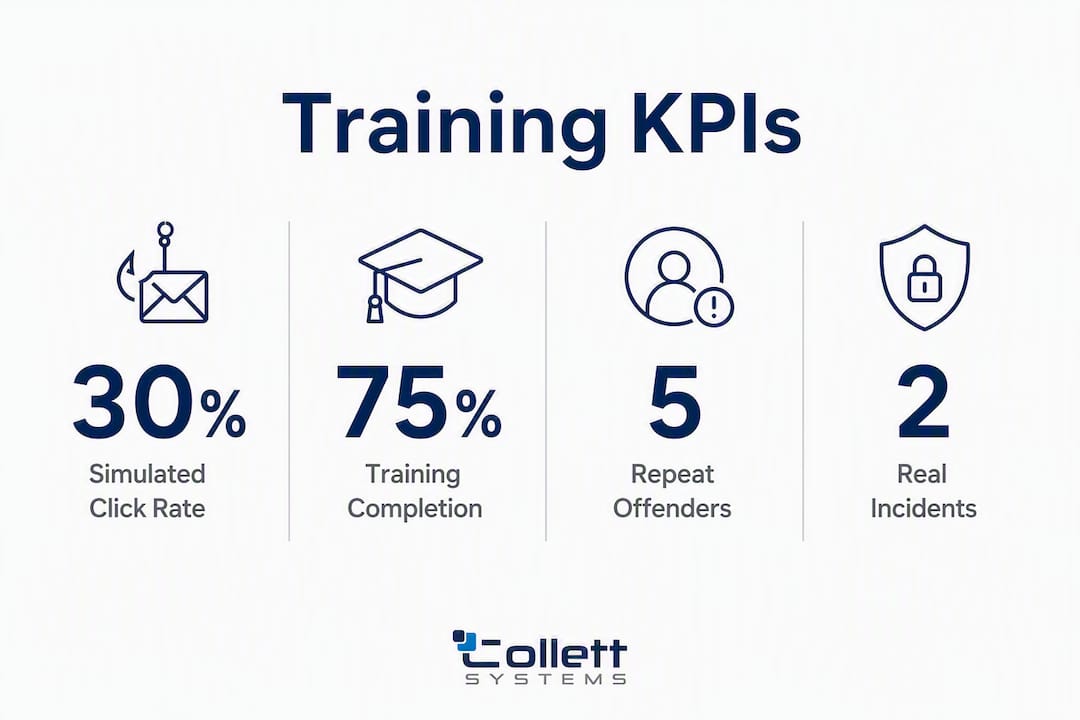
Your baseline simulation gives you the starting values. Every subsequent simulation and quarterly review shows movement. Leadership should see a monthly one-page summary with trend lines, not raw data dumps.
Microsoft’s simulation reporting identifies repeat offenders and coverage gaps specifically so you can direct remediation where it matters rather than running the same content for everyone. That targeting is what separates a program that improves over time from one that plateaus.
Combine simulation data with real incident metrics. If your simulated click rate drops but real phishing incidents stay flat, something else is broken, possibly your email filtering or your reporting culture. The two data streams together tell the full story.
Ready-to-use tips and a simple reporting workflow
These resources are designed to drop directly into your internal communications.
Employee phishing red flags (one-page tip sheet)
-
Sender address does not match the display name or domain
-
Urgent language demanding immediate action (“Your account will be suspended in 24 hours”)
-
Links that do not match the stated destination (hover before clicking)
-
Requests for credentials, wire transfers, or gift card purchases via email or text
-
Attachments you did not expect, especially.zip,.exe, or macro-enabled Office files
-
Generic greetings (“Dear Customer”) from vendors who normally use your name
Do not: Click links to verify. Call the sender using a number from your company directory, not one provided in the message.
Reporting workflow (step sequence)
-
Do not click anything in the suspicious message.
-
Report it using your email client’s “Report Phishing” button or forward to your designated IT contact.
-
Quarantine the message, do not delete it until IT confirms.
-
Notify your manager if the message referenced a financial transaction or sensitive data.
-
Change your password immediately if you already clicked a link or entered credentials.
-
For external reporting, forward phishing emails to reportphishing@apwg.org and report to the FTC at ReportFraud.ftc.gov.
No-blame phrasing for internal communications: “If you receive a suspicious message, report it immediately, no questions asked. Reporting a potential phish is always the right call, even if it turns out to be legitimate.”
Pro Tip: Pin the reporting workflow to your company intranet and include it in every new-hire onboarding packet. The faster employees can find the steps, the faster they act.
How Collett Systems LLC runs phishing training for SMBs
Collett Systems LLC manages phishing training programs for small and mid-size businesses across Southeastern Wisconsin as part of a fully loaded security awareness training service. The approach follows the same assess → simulate → remediate → evaluate structure that CISA and Microsoft recommend, but we handle the scheduling, reporting, and remediation workflows so your team does not have to.
Here is what a managed engagement looks like:
-
Paid IT and Security Assessment to establish your baseline click rate, identify high-risk roles, and document your current reporting workflow gaps.
-
Scheduled simulations on a monthly micro-sim and quarterly full-campaign cadence, with templates customized to your industry and common attack patterns in your region.
-
Automated microlearning assignment triggered by simulation results, employees who click get targeted remediation, not a generic course.
-
Monthly reporting package delivered to your leadership team: click rate trends, report rate trends, repeat offender summary, and recommended next actions.
-
24/7 monitoring paired with training so that real phishing attempts that slip through are caught at the infrastructure level, not just by employee awareness.
Collett Systems LLC serves over 150 local organizations on a fixed per-user pricing model, which means no surprise invoices when you add staff or run additional simulations. Our cybersecurity solutions pair technical controls, email filtering, MFA enforcement, endpoint detection, with the training program so both layers reinforce each other.
Pro Tip: Pair your phishing training program with identity-first security controls like MFA and conditional access. Training reduces the likelihood of a credential being surrendered; MFA limits the damage if one is.
Key Takeaways
A continuous, simulation-driven phishing training program, with a documented reporting workflow and measurable KPIs, is the most defensible approach a U.S. small or mid-size business can take against social engineering threats.
| Point | Details |
|---|---|
| Start with a baseline simulation | Run a silent phishing simulation before any training to establish your actual click rate. |
| Build a no-blame reporting workflow | Employees who fear blame stay silent; a clear, consequence-free reporting path is your fastest detection tool. |
| Track the right KPIs | Measure click rate, report rate, time-to-report, and repeat offender ratio, not just completion percentages. |
| Train continuously, not annually | CISA confirms once-a-year training is insufficient; monthly micro-sims and quarterly campaigns sustain behavior change. |
| Collett Systems LLC manages it for you | Fixed per-user pricing, scheduled simulations, automated remediation, and monthly leadership reporting, no internal overhead required. |
The part most businesses get wrong about sustaining behavior change
Most phishing training programs fail not because the content is bad, but because the program stops. A business runs a simulation in January, sends a training video in February, and considers the job done. By April, click rates are back where they started.
The conventional wisdom treats phishing training as a project with a finish line. It is not. It is an operational process, the same way patch management or access reviews are operational processes. The moment you treat it as a one-time initiative, you hand attackers the advantage.
What actually sustains behavior change is a combination of three things: consistent reinforcement through monthly simulations, visible executive participation, and a reporting culture where employees feel rewarded for flagging suspicious activity rather than embarrassed for nearly falling for it. Incentives do not have to be elaborate, a monthly shout-out to the team with the highest report rate costs nothing and moves behavior measurably.
Executive sponsorship is the piece most security leaders underestimate. When a CEO participates in a tabletop exercise or mentions the phishing program in an all-hands meeting, participation rates climb and the program earns organizational credibility it cannot get from IT alone. Pair that cultural foundation with technical controls, MFA, email filtering, endpoint detection and response, and you have a program that is genuinely hard to defeat.
The businesses we work with that see the most durable results are the ones that treat training as infrastructure, not a line item to cut when budgets tighten.
Collett Systems LLC: managed phishing training with no internal overhead
Running a phishing training program in-house takes a dedicated owner, a simulation platform, content management, and consistent reporting, resources most small and mid-size businesses do not have sitting idle. Collett Systems LLC delivers the full program under a fixed per-user monthly model, so you get scheduled simulations, role-based microlearning, automated remediation, and monthly leadership reports without adding headcount.
The starting point is a paid IT and Security Assessment that maps your current exposure, identifies your highest-risk roles, and produces a documented training roadmap. From there, we move into a pilot simulation and full rollout on a cadence that fits your team size and industry. Manufacturers, financial firms, and professional services businesses across Southeastern Wisconsin have used this model to build defensible, documented training programs that satisfy both leadership and compliance requirements.
Ready to see where your team stands? Book your IT and Security Assessment or review our managed IT services to see how phishing training fits into a fully managed security stack.
Authoritative sources and official guidance
Build your phishing training program on primary sources. These are the resources Collett Systems LLC references when designing defensible, compliance-ready programs for clients:
-
CISA, Teach Employees to Avoid Phishing: Guidance on continuous training, reporting workflows, and designating a threat-tracking owner. The starting point for any U.S. business.
-
CISA, NSA, FBI, MS-ISAC, Phishing Guidance: Stopping the Attack Cycle at Phase One: The most detailed federal guidance available, covering attack techniques, defender recommendations, and retention check requirements. Directly applicable to small and mid-size organizations.
-
FTC, Phishing Guidance for Small Businesses: Practical guidance on training schedules, participation enforcement, and external reporting routes including ReportFraud.ftc.gov.
-
Microsoft Learn, Attack Simulation Training Insights: Detailed reporting guidance including repeat-offender identification, coverage gap analysis, and remediation tracking.
-
Verizon, 2026 Data Breach Investigations Report: The industry benchmark for breach patterns, human element statistics, and multi-channel attack data. Use it to justify budget and program scope to leadership.
-
NIST, Phishing Guidance for Small Businesses: No-cost checklists and self-assessment questions for organizations building a program from scratch.
Check your domain's email trust score
Free 60-second tool, see how your SPF, DKIM, and DMARC look to recipients.